About Epidendrum cochlidium Lindl.
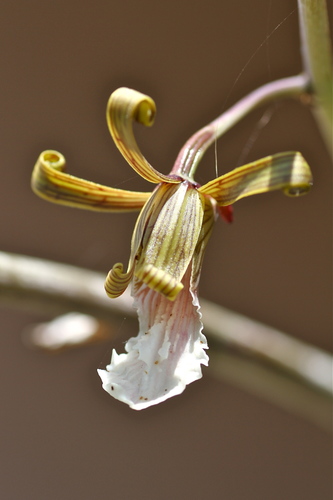
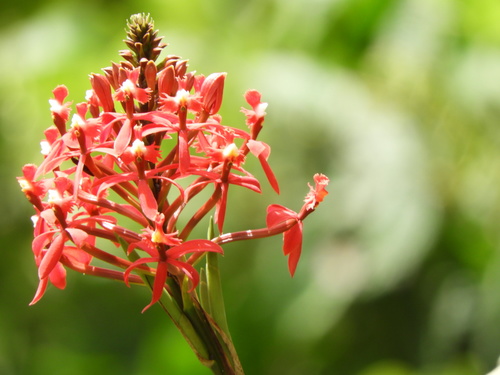
Epidendrum cochlidium Lindl. belongs to the subgenus Epidendrum subg. Amphiglottium. This subgenus is defined by the following characteristics: sympodial growth habit, terminal inflorescences, tight imbricating distichous sheathes covering stems and peduncles, stems that do not swell into pseudobulbs, terminal inflorescences that are nearly always racemose, and flowers with the lip adnate to the sides of the column all the way to its apex. In 1861, Reichenbach described the stem of this species as terete and gracile, while in 1960 Schweinfurth described it as "more or less stout". The leathery leaves are ovate-oblong, obtuse and emarginate, with basal sheathes that cover the upper part of the stem. Leaves grow up to 12 cm long and 2.5 cm wide. The peduncle can reach 0.6 m long and terminates in a congested raceme; rarely, the inflorescence will branch to form a panicle. The petals and sepals range from linear-lanceolate to elliptic-oblong and are nearly the same size, with petals only slightly smaller than sepals. Consistent with the classification of this species in section Epidendrum sect. Schistochila, the lip is divided into three lobes. Consistent with its placement in subsection Epidendrum subsect. Tuberculata, the lobes are lacerate, and a tubercle covers the center of the lip. The crested and plicate tubercle is white to cream or yellow, and the rest of the flower is red, pink, or yellow. The flowers of Epidendrum cochlidium are non-resupinate. The diploid chromosome number of this species has been determined as 2n = 28.