About Epidendrum blepharistes Barker ex Lindl.
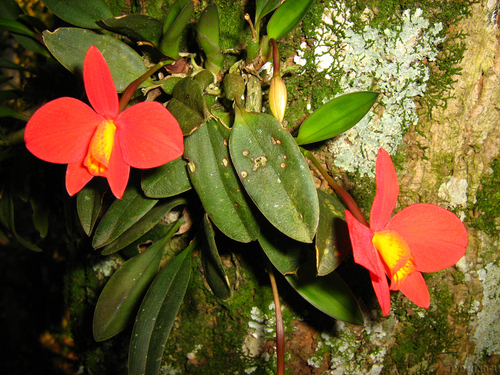
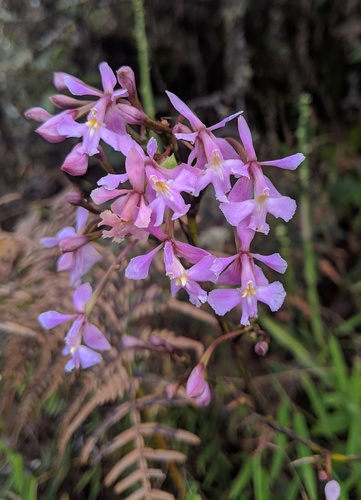
Epidendrum blepharistes Barker ex Lindl. grows as both a terrestrial and epiphytic plant, occurring at altitudes between 1.0 km and 3.0 km in the Neotropics. Like other species in the subgenus Epidendrum subg. Amphiglottium, E. blepharistes has a sympodial growth habit. Individual stems are covered from the base by tight, tubular sheaths; on the upper portion of the stem, these sheaths form the bases of distichously arranged leaves. Unlike most members of E. subg. Amphiglottium, E. blepharistes often has a fusiform swelling at the base of each stem that can reach up to 1.5 decimeters in length. Its leaves are elongate, ovate, and obtuse, and can grow to more than 22 centimeters long and 3 centimeters wide. The terminal peduncle is covered from its base by tight tubular sheaths, and bears either a loose panicle (as is typical for the section E. sect. Polycladia) made up of a small number of distant racemes, or a single raceme. The small flowers are a deep rose color. They have oval sepals up to 10 millimeters long and 4 millimeters wide, acuminate petals that are nearly the same length as the sepals but have denticulate margins, and a quadrilobate lip that is adnate to the column all the way to the column's apex. Schweinfurth (1959) described the lip as "deeply 3-lobed", and further noted that the mid-lobe is "deeply bilobed at the apex". The lateral lobes of the lip are more or less fringed. Two calli are present where the lip branches away from the column, with a keel between them that extends partway down the medial lobe of the lip. The diploid chromosome number of E. blepharistes has been recorded as 2n = 40.