About Epicharis parasitica (Osbeck) Mabb.
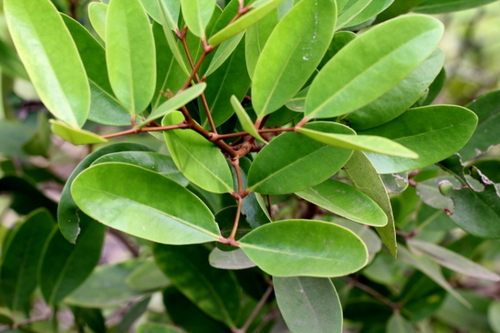
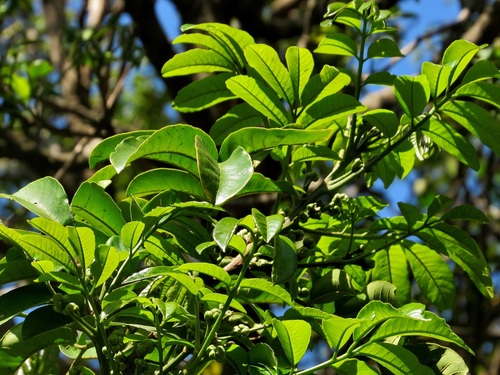
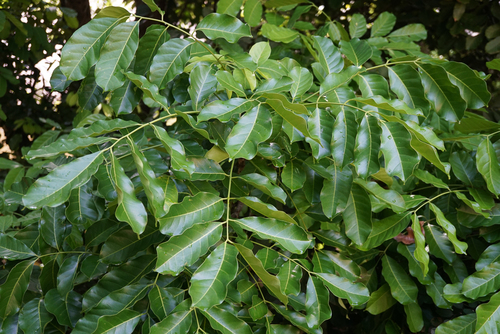
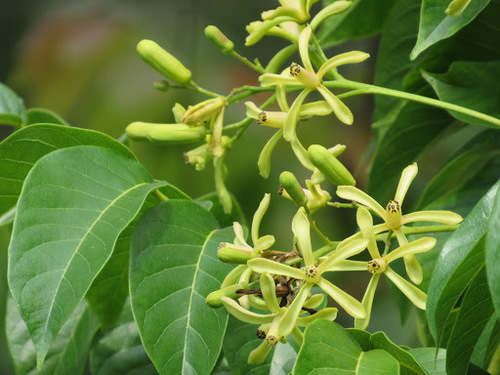
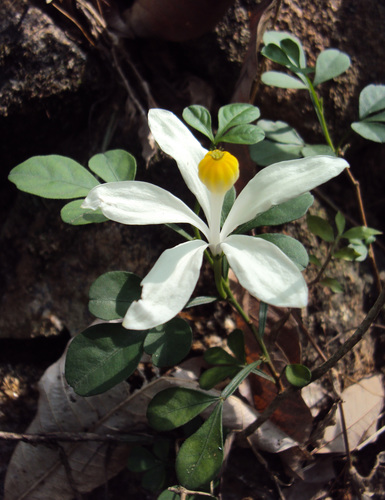
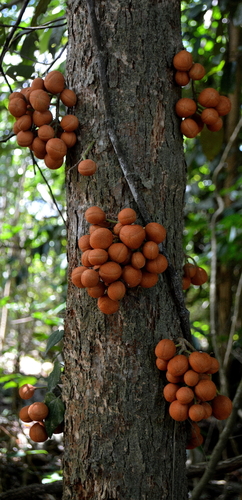
Epicharis parasitica (Osbeck) Mabb. is a tree that can reach up to 36 m (118 ft) in height, with a trunk diameter of up to 60 cm (24 in). It may grow buttresses that reach up to 1.5 m (4 ft 11 in) in both height and width. Its bark ranges from yellowish to grey-brown, and has a texture from smooth to flaky, with scattered lenticels. Its compound leaves are arranged spirally on twigs, and can grow up to 1.5 m (4 ft 11 in) long, bearing up to 19 leaflets. Leaflets are oblong to ovate in shape, growing up to 19 cm (7.5 in) long by 6 cm (2.4 in) wide, with approximately 14 lateral veins on each side of the midrib. Its inflorescence is a raceme up to 30 cm (12 in) long; this structure grows either from protrusions on the tree trunk via cauliflory, or from woody branches via ramiflory. The sweetly scented flowers are white or cream, with four petals. The white staminal tube measures around 15 mm (0.59 in) long and 4 mm (0.16 in) wide. The fruit is a globose red-brown capsule with a diameter of about 4 to 5 cm (1.6 to 2.0 in), it has up to four segments, each holding one seed. Seeds are around 2 cm (0.79 in) long, brownish-black, and covered by an orange-red sarcotesta. This species, commonly called yellow mahogany, has a natural distribution across Taiwan, the Philippines, Borneo, Sumatra, Java, Sulawesi, Maluku, East Timor, New Guinea, the Bismarck Archipelago, the Solomon Islands, and Queensland. It grows in mature rainforest, including rainforest on limestone, at altitudes ranging from sea level to around 2,100 m (6,900 ft). The tree's flowers are visited by butterflies, which are important pollinators for the family this species belongs to. Possums and bats also contribute to pollination, as they climb the tree trunk searching for food. Epicharis parasitica has potential use as a feature tree for parks or gardens in subtropical or tropical climates. In cultivation, it prefers acid soils with good drainage, and grows best in dappled sun or part-shade. The species can be propagated using fresh seed.