About Epicauta vittata (Fabricius, 1775)
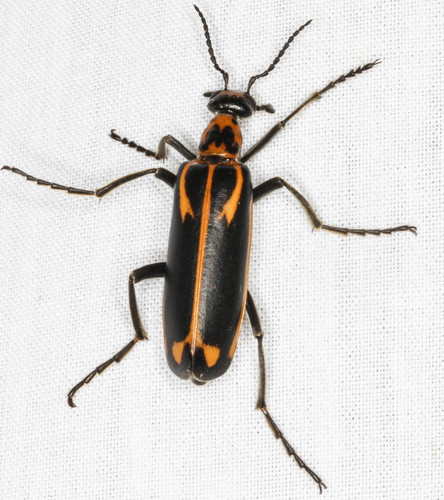
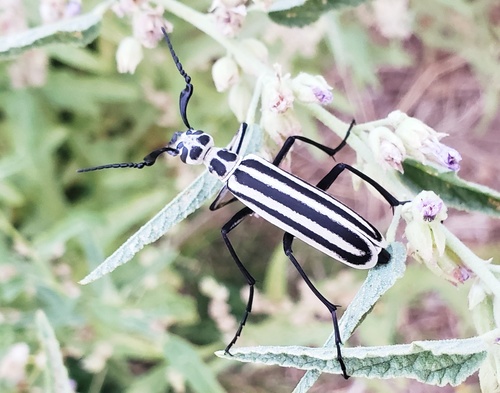
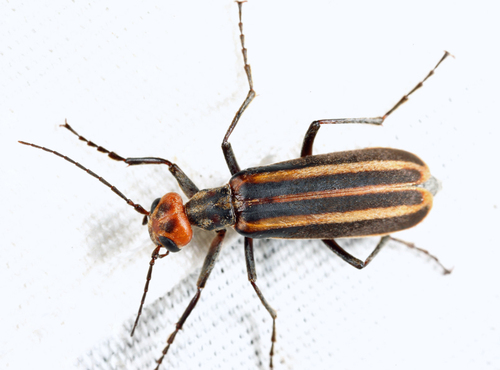
Epicauta vittata, commonly called the striped blister beetle, has an adult body length ranging from 9 to 17 millimeters. Adults have a long, slender, hairy, punctate body, with a thorax that is narrower than both the head and abdomen. Their body is patterned in black and yellow, with coloration that varies by geographical range. They have two black spots on the head, two black stripes on the thorax, and two or three black stripes on each elytron. Individuals from northern populations have two elytral stripes, while those from southern populations have three. The larva of this species is a triungulin, and its appearance changes as it develops. Newly hatched larvae are whitish, with long legs that make them mobile. During this mobile stage, larvae parasitize grasshopper egg cases. After reaching the egg case, the larva develops into a sedentary grub. At this stage, the body darkens to a reddish-brown color with darker bands, and the legs shrink in size. Like many blister beetles, this species has a complex developmental cycle, with larvae and pupae undergoing major morphological changes between different growth phases. There are one or two generations per year. Adult numbers peak in summer, or slightly earlier in climates that are more hospitable. Adult females produce new batches of eggs approximately every 10 days. Females deposit eggs in masses of 100 to 200, inside a tubular chamber dug a few centimeters deep into soil, then cover the chamber after laying. The eggs are whitish, around 2 millimeters long, and hatch within 16 days. New larvae use their functional legs to search for their food source: grasshopper eggs. As they feed and develop at this food source, their legs become reduced in size. This blister beetle is associated with grasshopper species that produce large egg pods, including the two-striped grasshopper (Melanoplus bivittatus) and the differential grasshopper (Melanoplus differentialis). Known predators of the striped blister beetle include robber flies and multiple bird species: the western meadowlark, eastern bluebird, and scissor-tailed flycatcher. Its eggs are targeted by another blister beetle species, Epicauta atrata. Frogs are apparently not affected by the toxin produced by blister beetles in the family Meloidae, and consume these beetles without negative effect. After eating blister beetles, frogs retain the toxin in their tissues and secrete it into their mucus for a short period. Any predator that eats these toxin-carrying frogs can be poisoned, including humans who eat frog legs from such frogs. Studies on northern leopard frogs fed striped blister beetles found that the beetles' toxin cantharidin accumulated in the frogs' thigh muscles and other tissues. It has been estimated that as little as 200 grams of frog legs from frogs that fed on these blister beetles could contain a potentially fatal dose of the toxin.