About Epiblema foenella (Linnaeus, 1758)
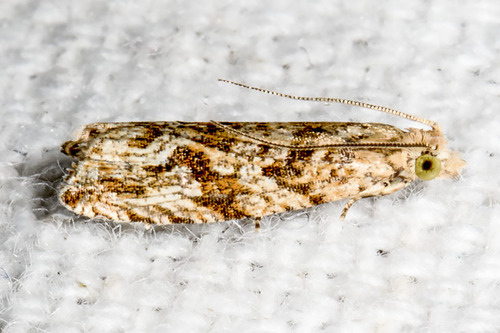
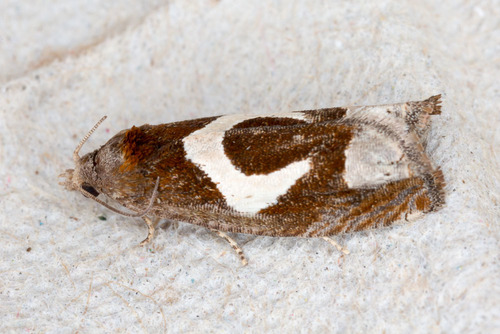
Epiblema foenella, the white-foot bell moth, has a wingspan of 17 to 26 millimeters. This fairly common species has dark brown forewings, which feature a striking, falcate, medio-dorsal white marking whose shape varies quite considerably, plus a gray-colored area at the wingtips. This moth produces one generation per year, and mature caterpillars overwinter. Larvae feed on the roots and lower stems of mugwort (also called common wormwood, Artemisia vulgaris), southernwood (Artemisia abrotanum), and golden marguerite (Anthemis tinctoria). Adults fly from May to August, depending on location, and are typically active from late afternoon into the evening. This species is distributed across most of Europe, southern Russia, the Caucasus, Siberia, Kazakhstan, Kyrgyzstan, Mongolia, the Russian Far East, China (including the regions of Tianjin, Hebei, Inner Mongolia, Jilin, Heilongjiang, Jiangsu, Zhejiang, Anhui, Fujian, Jiangxi, Shandong, Henan, Hubei, Hunan, Guangxi, Sichuan, Guizhou, Yunnan, Shaanxi, Gansu, Qinghai, Ningxia, and Xinjiang), Korea, Japan, India, Taiwan, and Vietnam. The white-foot bell prefers habitats including rough uncultivated ground, grassland, scrub, river banks, and coastal cliffs.