About Ephippiger terrestris Yersin, 1854
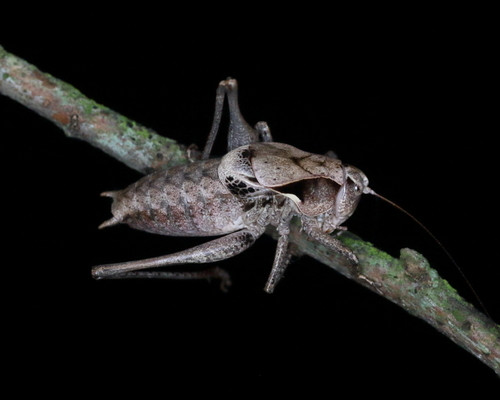
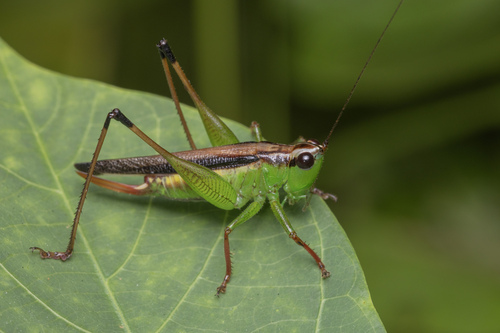
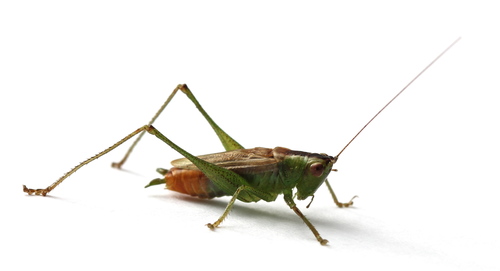
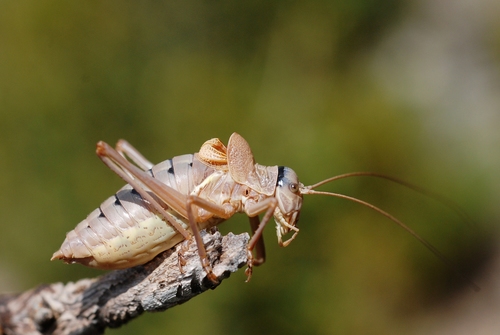
Ephippiger terrestris is a species of bush cricket. Adult males reach a body length of approximately 23–28 mm (0.91–1.10 in), while adult females reach 28–32 mm (1.1–1.3 in). The female ovipositor measures about 25–28 mm (0.98–1.10 in). Most individuals are bluish-green, but body color varies considerably in both sexes, with common variations including olive-green, beige, and sepia-brown. A yellowish line runs from the lower edge of the pronotum to the tip of the abdomen, and two bright longitudinal lines run along the sides of the back. The back of the head is black. The pronotum has a rather smooth, gently concave shape that resembles a saddle; the species' genus name comes from the Latin ephippium, meaning 'horse's saddle'. This species has small, rounded, atrophied wings that protrude a few millimeters below the pronotum. These wings are not capable of supporting flight, and are only used for sound production via stridulation. Female Ephippiger terrestris have a long ovipositor that curves slightly upward. Males have prominent, cylindrical, relatively long cerci. This species is found in central and southwestern Europe, specifically in France, Italy, and Switzerland. The subspecies Ephippiger terrestris bormansi is restricted to northern Italy and southern Switzerland. It inhabits warm mountain meadows and pastures, open rocky areas, and dwarf shrub habitats, at elevations between 1,000 and 2,000 metres (3,300–6,600 ft) above sea level.