About Ephedra monosperma J.G.Gmel. ex C.A.Mey.
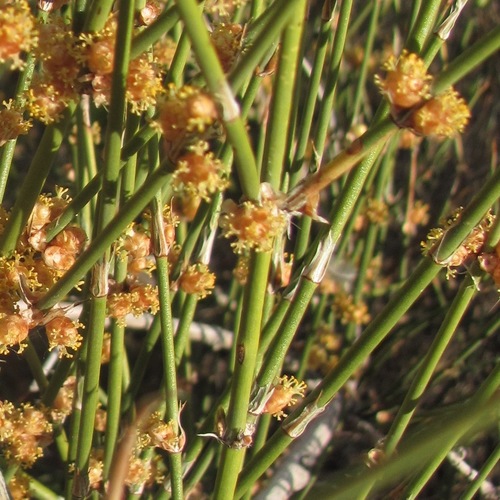
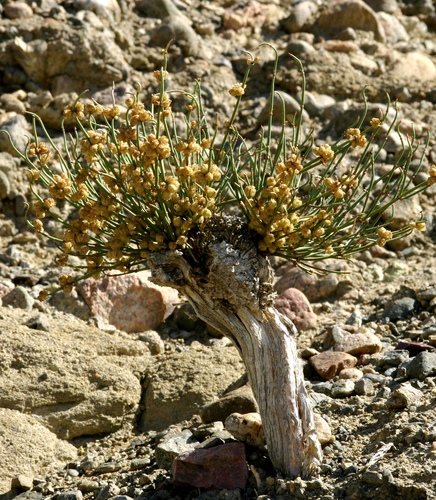
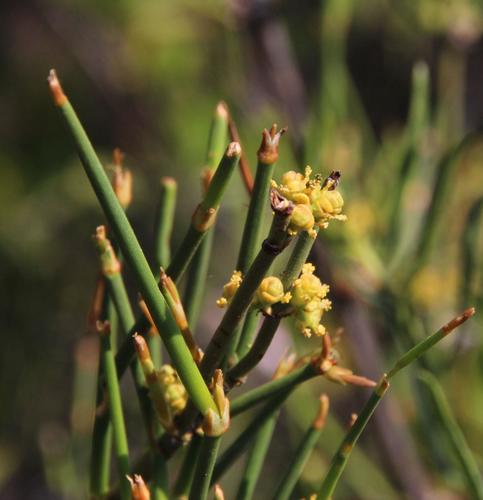
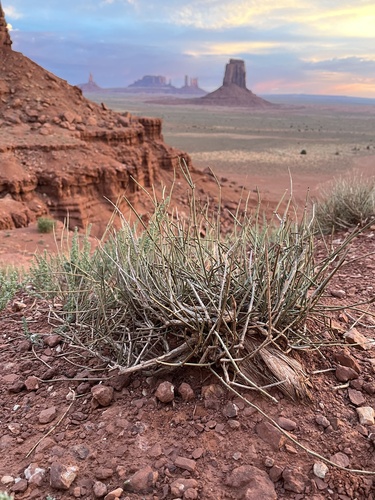
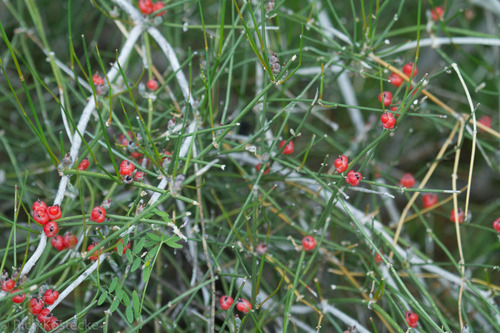
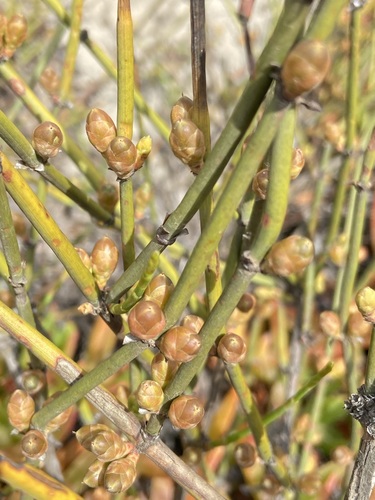
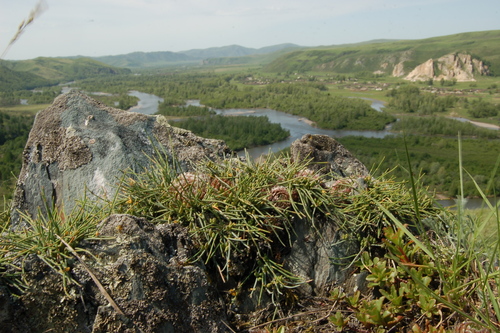
Ephedra monosperma J.G.Gmel. ex C.A.Mey. is a perennial small shrub that grows 5 cm to 15 cm high, and often produces creeping runners. Its woody stems are short, much-branched, reaching 1 to 5 cm in length, and have knotted nodes. Branchlets are spreading, slender, and usually slightly curved. Internodes on these branchlets are 1–3 cm long and 1 mm in diameter. Leaves are arranged oppositely, with their basal 1/3 to 2/3 of their length fused together. Each female cone contains a single ovule, which is enclosed by two pairs of cone bracts. Pollen cones are oblong-spherical in shape, and consist of three or four pairs of decussate (opposite, cross-arranged) scales with broad margins. They are sessile or subsessile at nodes, and grow in pairs, or more rarely as solitary structures. Pollen cone bracts are arranged in two to four pairs, with half of their length fused together. This species flowers from May, pollinates in June, and produces mature seeds in August. Seed cones are sessile, grow solitary or oppositely at nodes, and are ovoid when mature. Mature seed cones are fleshy, red, sweet-tasting, 6–9 mm long, and 5–8 mm across. Ephedra monosperma grows in limestone crevices, on cliffs, and on rocky slopes; it sometimes occurs on rocks on the slopes of river valleys, where it is often found alongside sparse Juniperus and other shrub vegetation. It also frequently grows in dry pine forests. It is distributed across Asia, in Afghanistan, China (Beijing, Chongqing, Gansu, Guizhou, Hebei, Hubei, Nei Monggol, Ningxia, Qinghai, Shandong, Shanxi, Sichuan, Tianjin, Xinjiang, Yunnan, and Tibet), Kazakhstan, Mongolia, Pakistan, and Russia (Buryatiya, Chita, Irkutsk, Krasnoyarsk, Tuva, and Yakutiya). Ephedra monosperma is part of the group of Ephedrae herbs that have been used in Chinese and Japanese medicine for several thousand years. Ephedra-based medicines have a wide range of pharmacological effects: they increase heart rate and raise blood pressure to counter heart block or postural hypotension, constrict peripheral blood vessels, produce bronchodilation to treat bronchial asthma, stimulate the central nervous system to counter narcolepsy or depression, and reduce urine output to counter urinary incontinence. Pure ephedrine alkaloid extracted from Ephedra herbs is a well-known effective treatment for asthma, particularly because it can be administered orally, unlike adrenaline. Ephedrine products have been banned in the United States since 1994, due to causing a range of serious adverse effects including headache, insomnia, stroke, arrhythmias, myocardial infarction, psychosis, heart palpitations, cardiac arrest, and even death.