About Epacris paludosa R.Br.
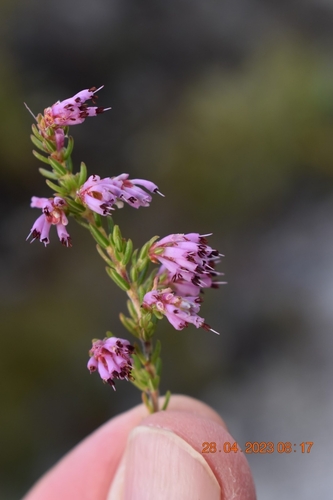
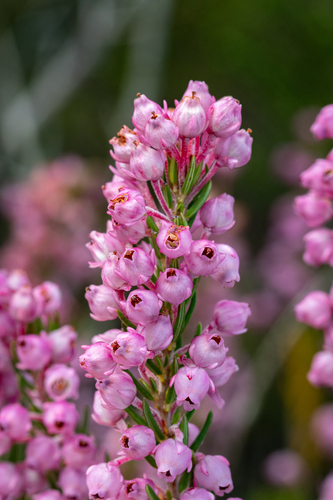
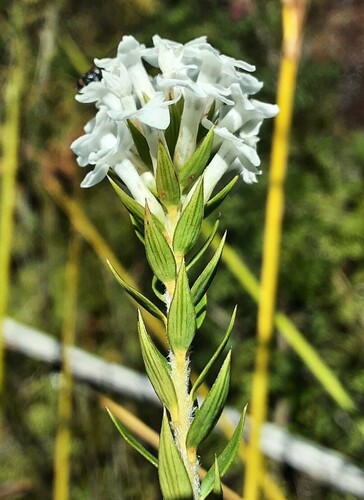
Epacris paludosa R.Br. is an erect, bushy shrub that typically grows 0.1 to 1.6 meters (3.9 inches to 5 feet 3 inches) tall. It has hairy branchlets marked with prominent leaf scars. Its leaves are lance-shaped, elliptic, or egg-shaped, 5 to 13 millimeters long and 1.5 to 3.0 millimeters wide, borne on a petiole about 1 millimeter long, with fine teeth along the leaf edges. Flowers are arranged in crowded, leafy heads along the uppermost 60 millimeters of the stems. Each flower sits on a peduncle 1.0 to 1.5 millimeters long, with 14 to 22 bracts. The sepals are egg-shaped, 4.0 to 5.5 millimeters long with a pointed tip. The petals are white, joined at the base to form a cylindrical or bell-shaped tube 4 to 6 millimeters long, with lobes 3.0 to 3.5 millimeters long. Flowering occurs year-round, with a peak flowering period from September to January. This species, commonly called swamp heath, grows in swampy areas and wet heath. Its range extends from south of Sydney and the Blue Mountains in New South Wales to eastern Victoria and Flinders Island in Tasmania, growing at elevations from sea level up to 1,700 meters (5,600 ft). In the Sydney region, Epacris paludosa grows alongside Viminaria juncea (native broom), Banksia paludosa (marsh banksia), and Leptospermum lanigerum (woolly teatree). Individual plants live more than 60 years and resprout after fire.