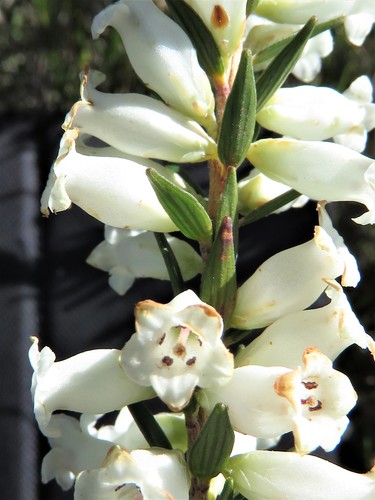
About Epacris obtusifolia Sm.
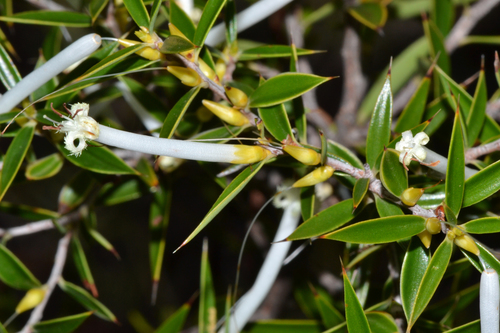
Epacris obtusifolia Sm. is an erect shrub that usually has few stems, and typically grows between 0.5 and 1.5 metres (1 foot 8 inches to 4 feet 11 inches) tall. Its branchlets are covered in soft hairs. Its leaves are oblong to elliptic, between 3.5 and 11 millimetres (0.14 to 0.43 inches) long, and 1.0 to 3.1 millimetres (0.039 to 0.122 inches) wide, growing from a petiole 0.5 to 2 millimetres (0.020 to 0.079 inches) long. The leaves have a wedge-shaped base and a blunt tip.
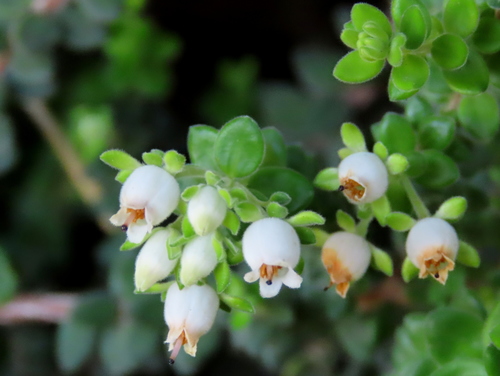
The flowers are arranged along up to 150 millimetres (5.9 inches) of the plant's stems, growing from a peduncle up to 1.5 millimetres (0.059 inches) long. The sepals are 3.9 to 7 millimetres (0.15 to 0.28 inches) long. The petals are white or cream-coloured, joined at the base to form a cylindrical or bell-shaped tube 4.8 to 14.2 millimetres (0.19 to 0.56 inches) long, with lobes 1.6 to 4 millimetres (0.063 to 0.157 inches) long. Flowering occurs year-round, with a peak flowering period from July to January.
This species, commonly called blunt-leaf heath, grows in swampy areas and heathland across eastern Australia. It occurs along the coast and nearby tablelands of south-eastern Queensland, eastern New South Wales, southern Victoria, and Tasmania. In the Sydney region, Epacris obtusifolia grows alongside coral fern (Gleichenia dicarpa), swamp banksia (Banksia robur), and the sedge Lepidosperma limicola.
Individual plants of this species live between ten and twenty years. They are killed by fire, and regenerate from seed that remains dormant in the soil. Seedlings reach flowering maturity within four years.
In horticulture, Epacris obtusifolia can be propagated from cuttings, and requires a well-drained but moist garden position. It was first cultivated in the United Kingdom in 1804.