About Epacris lanuginosa Labill.
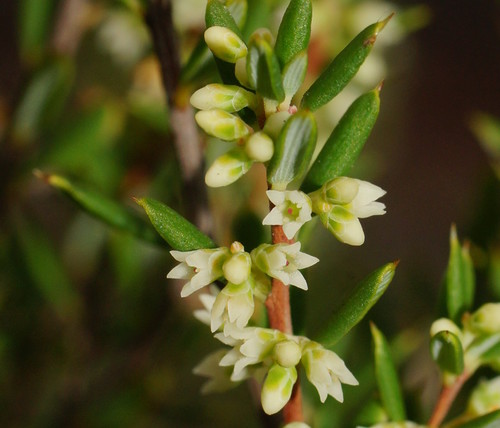
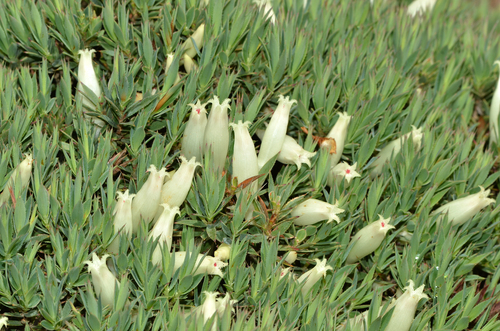
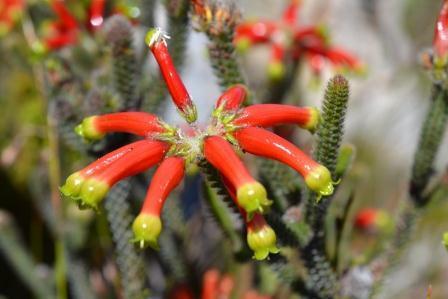
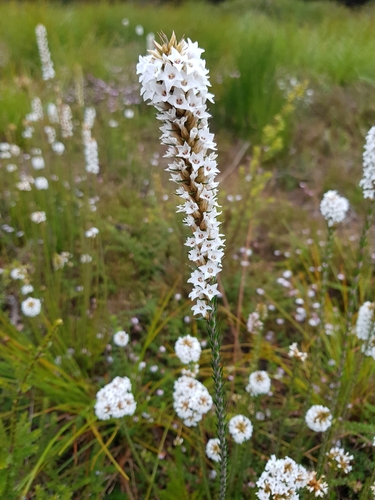
Epacris lanuginosa, commonly called woolly-style heath, is a slender, erect shrub that typically grows up to about 1.6 metres (5 feet 3 inches) tall. It has branchlets covered in woolly hairs. Its leaves are crowded, linear to lance-shaped, 5–13 mm (0.20–0.51 in) long and 0.6–3 mm (0.024–0.118 in) wide; they are either sessile, or borne on a petiole up to 1 mm (0.039 in) long. The flowers are arranged at branch ends, or in leaf axils along the upper 10 cm (3.9 in) of branches. Each flower has between 13 and 30 bracts at its base. The sepals are lance-shaped, 4.5–7.5 mm (0.18–0.30 in) long. The petal tube is cylindrical to narrowly bell-shaped, 4.5–8 mm (0.18–0.31 in) long, with lobes 2.7–4 mm (0.11–0.16 in) long. The anthers are entirely enclosed inside the petal tube. Flowering occurs mainly from August to January. Woolly-style heath is common in boggy areas of Tasmania. It also grows in wet heath, scrub, and forest at low elevations in southern and western Victoria, and the Southern Tablelands of New South Wales. Epacris lanuginosa is susceptible to root rot, an exotic fungal disease caused by Phytophthora cinnamomi.