About Eophona personata (Temminck & Schlegel, 1848)
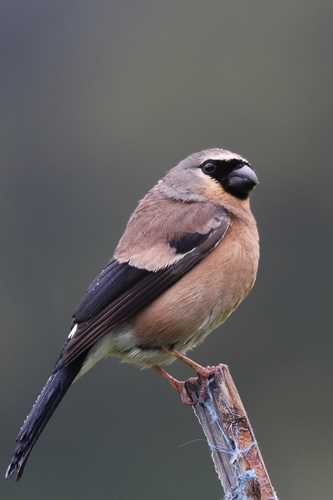
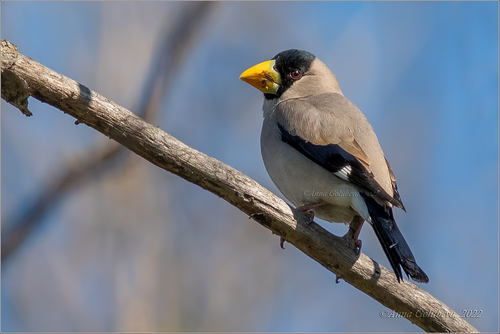
Eophona personata, commonly called the Japanese grosbeak, is a large finch. One recorded male specimen weighed 80 g (2.8 oz), and the species has an overall body length of 18 to 23 cm (7.1 to 9.1 in). Standard measurements across the species show a wing chord length of 10.2 to 11.7 cm (4.0 to 4.6 in), a tail length of 8.3 to 9.5 cm (3.3 to 3.7 in), and a culmen length of 2.1 to 2.6 cm (0.83 to 1.02 in). Its most distinctive feature is a large, pointed, bright yellow bill. Adults have a large black marking that stretches from the nape to the chin, and from the ear-coverts to the neck. The side of the neck is contrasting pale whitish grey, while the bird's underside is duller grey. The back is greyish-brown, and the flanks are tinted with gingery or tawny-brown. The wings and tail are black, with the exception of a white patch on the inner coverts and a white band in the middle of the primaries that is visible during flight. Juveniles are duller grey overall and lack the black head marking found on adults. The recognized subspecies E. p. magnostris is slightly larger than the nominate subspecies, generally paler in overall tone, and has a smaller white patch on its primaries. Japanese grosbeaks produce a short, hard tak tak call when in flight, and their song is made up of a series of four flutey whistles. The alternate subspecies E. p. magnostris is fully migratory: it breeds in regions around the Amur, Ural, and Manchuria, then winters in Hebei and Beijing, and uncommonly ranges as far south as North Korea. The nominate race is found in Japan from Hokkaido to Kyushu; it does not undertake regular seasonal migration, but does wander widely in winter, mostly to search for food sources. The Japanese grosbeak is locally common, and can occasionally be abundant in good prime feeding areas. It lives in deciduous or mixed forests, and is more commonly found in valleys than on hillsides. It also appears in oak and birch woods and groves, well-wooded parks and gardens, and may winter on the edge of cultivated areas. Japanese grosbeaks usually occur in pairs or small flocks. They can be surprisingly secretive, and often stay hidden in foliage near the tree canopy, but their location is regularly given away by their vocalizations. They feed mostly on a wide variety of seeds and insects. In winter, they primarily eat cedar nuts, and will also feed on birch seeds and berries. In summer, they are largely insectivorous, and regularly eat caterpillars and beetles.