About Enterolobium cyclocarpum (Jacq.) Griseb.
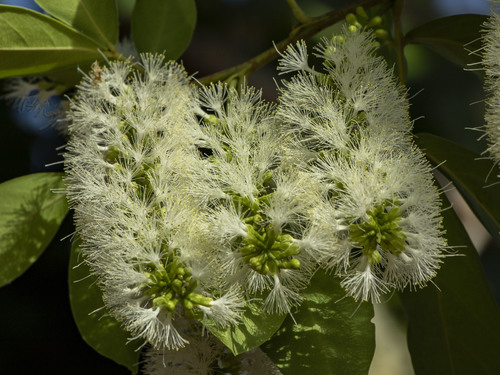
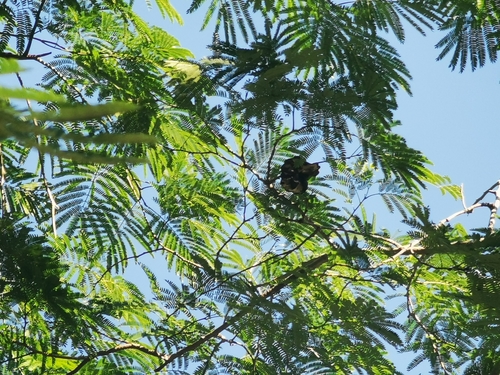
Scientific name: Enterolobium cyclocarpum (Jacq.) Griseb., commonly called guanacaste or parota. This species is a medium to large tree that reaches 25–35 m (82–115 ft) in height, with a trunk up to 3.5 m (11 ft) in diameter. Unusually for a tree of this size, it has completely no buttresses. Its bark is light gray marked with prominent vertical dark reddish-brown fissures; in young saplings, the closer spacing and merging of these fissures gives the bark a characteristic reddish hue. Bark on older specimens is often broken, chipped, or scarred. Guanacaste has a broad, widely spreading crown, and both the lowest branching height on the trunk and overall tree shape vary substantially between individuals, depending on habitat. When growing as a single open-grown specimen in a sunny pasture, it develops massive, extended horizontal limbs starting low on the trunk, forming a giant, hemispherical, widely spreading crown. In forests with intense competition for light, trees grow taller, branch higher up the trunk, and develop a somewhat narrower overall form, though mature canopy trees still maintain rounded, hemispherical crowns. Its leaves are alternate bipinnate compound leaves, 15–40 cm (5.91–15.75 in) long and 17 cm (6.69 in) broad, with a 2–6 cm (0.79–2.36 in) petiole that holds 4 to 15 pairs of pinnae. Each pinna holds 40–70 slender, oblong leaflets, 8–15 mm (0.315–0.591 in) long by 2–4 mm (0.079–0.157 in) wide. A small, raised, oval gland grows near the base of the twiggy petiole. Leaves are only found on the outer portion of the crown, but are numerous enough to keep the crown moderately dense and green. Guanacaste is either evergreen, or briefly deciduous for 1–2 months during the dry season. Most foliage drops in December at the start of the dry season; a new growth surge begins in late February that re-establishes a thick, fresh crown by April. Globular 3 cm (1.18 in) inflorescences grow in the axils of new leaves at the same time new foliage develops. Each inflorescence is a spherical white flower head held on a 4 cm (1.57 in) long stalk, made up of around 50 individual flowers, and its most prominent feature is thousands of thin filamentous stamens. Each individual flower has about 20 stamens and one pistil, held together at the base by a short green tubular corolla and an even shorter calyx, with a total length of just 5 mm (0.197 in). Guanacaste flowers are strongly fragrant, and during heavy blooming periods their scent permeates the air for many meters in all directions. In Manuel Antonio National Park near Quepos, Costa Rica, flowering runs from late February to early April. After flowering ends, fruit development does not begin immediately; 9–10 months pass before small green pods first appear high in the crown by December. Pods reach full size by February and begin ripening in March, a full year after flowering started. Fruit ripening runs from March to April, as green pods turn brown in the crown and are gradually shed. Vigorous trees produce large seed crops almost every year. By June, guanacaste seedlings can already be found germinating in moist soil from the early rainy season. Mature guanacaste fruits are large 7–12 cm (2.8–4.7 in) diameter, glossy dark brown, indehiscent, spirally arranged pods shaped like orbicular disks. This shape forms when the typical long, narrow, flattened pod of a Mimosoideae is wound around an axis perpendicular to the pod's plane. The pods are made of thick, soft tissue with a leathery texture, and contain 8 to 20 radially arranged seeds. The seeds are 14.5–17.5 mm (0.571–0.689 in) long, 7.8–11.2 mm (0.307–0.441 in) wide, 6.2–7.2 mm (0.244–0.283 in) thick, and weigh approximately 1 g. Guanacaste seeds are brown with a noticeable light brown or orange ring, and are extremely hard, with a strength and durability that resembles small stones rather than typical tree seeds. For germination to occur, the hard seed coat must be broken to let water reach the embryo; otherwise, seeds will remain dormant indefinitely. Two other tree species, Cojoba arborea (ardillo) and Dilodendron costaricense (iguano), have similar fine-leafed bipinnate leaves and grow to a similarly large size, but can be easily distinguished from guanacaste. Ardillo has tan, heavily wrinkled, rough bark that is nothing like guanacaste's distinctly gray, vertically fissured bark. Iguano has serrated leaflets, an unusual trait for a bipinnate tree, while guanacaste leaflets are smooth-edged (entire). In terms of ecology, guanacaste delays fruit development by roughly 9 months so seed maturation lines up with the start of the rainy season. This is thought to be an adaptation that gives germinating seedlings as much time as possible to establish root systems before the next dry season, a reproductive strategy it shares with Hymenaea courbaril (jatobá) and Albizia saman (cenizaro). Like other deciduous and semideciduous species native to the region, guanacaste gains water-conserving benefits from dropping its leaves in the dry season. Bees frequently visit guanacaste flowers and are likely the species' main pollinators. Currently, native fauna completely ignore guanacaste seed pods, which accumulate on the forest floor under parent trees, and no native animals eat the seeds. This has led to the suggestion that guanacaste is an evolutionary anachronism: its pods were likely consumed and dispersed by Pleistocene megafauna species that went extinct around 10,000 years ago, such as giant ground sloths and giant bison, and today the tree has no effective native seed disperser besides humans. The hard seed coat that prevents germination unless punctured may also be an adaptation to stop seeds from germinating while still in pods, or after falling under the parent tree at the start of the rainy season, giving extinct foraging mammals time to consume pods and carry seeds to new locations. Mastication and digestion of the fruit by these mammals would abrade the seed coat to promote germination. Today, this dispersal and mastication role is primarily filled by domestic horses and cattle. An insect pest common to guanacaste trees in Costa Rica's Central Valley produces 1.5 cm (0.59 in) diameter spherical green galls on new shoots in February and March; similar parasitism also occurs on guanacaste trees in the wet southwestern lowlands around Palmar Sur, Costa Rica. Guanacaste is widely cultivated and used across its native range. It is tolerant of a wide range of rainfall levels, temperatures, and soil conditions, and grows well in most low-elevation tropical habitats. It is highly valued as an ornamental tree, and the large amount of shade it creates forms cool oases on the sun-baked Pacific slope plains of its native range. It is commonly grown as a shade tree for coffee plantations, as well as for shade and forage for cattle, and improves soil fertility through nitrogen fixation. It grows in USDA Growth Zones 10–12. Its wood is reddish-brown, lightweight, with a density of 0.34–0.6 g/cm3 (0.20–0.35 oz/cu in), and water-resistant. It is used to make doors, windows, furniture, cabinets, and for shipbuilding. It has high chatoyance, with an average value above 20 PZC. It is considered a relatively sustainable resource for wood furniture and design, because the tree grows quickly to large size, making it easy to source large natural cuts up to several meters long that are rare for slower-growing woods like oak or cedar. The town of La Cruz de Huanacaxtle in Nayarit, Mexico gets its name from an old cross that once stood there made of guanacaste wood. When pods are still green, they are harvested and their seeds are eaten boiled in Mexico. Healthy guanacaste trees produce massive, nearly annual seed crops. The attractive seeds are used to make jewelry in Costa Rica. In parts of Panama, ripe seeds are heated over fire until they pop like popcorn. Guancaste seeds have a nearly 100% germination rate, and seedlings grow rapidly, often reaching over 1 m (3 ft 3 in) tall in their first year. This aggressive reproductive traits could be useful for reforestation projects, though the species is considered invasive in some areas. Large guanacaste trees have strong roots that can damage nearby built structures. Guanacaste is commonly used to feed all types of livestock; its foliage, fruits, and seeds are eaten by cattle, pigs, goats, sheep, and horses. The parota tree is credited with medicinal properties in folk tradition. In Mexican folk medicine, sap is used to treat influenza and bronchitis, while the astringent properties of green fruit are used to treat diarrhea. Fruit and bark contain tannins that are used for leather curing and soap manufacturing. Sap can be used as a natural adhesive to replace glue, or chewed as a type of gum.