About Entelea arborescens R.Br.
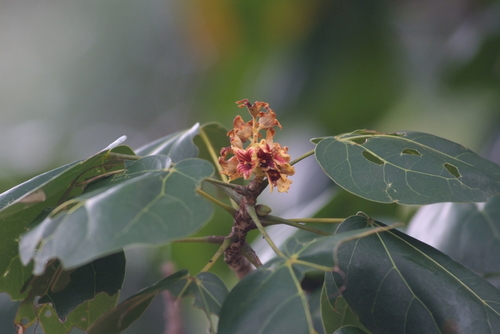
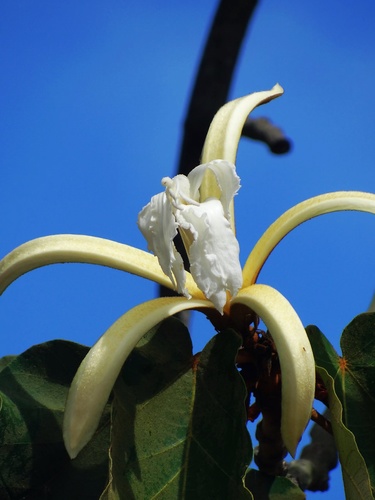
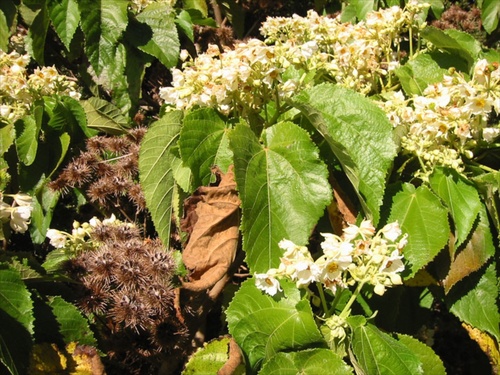
Entelea arborescens (common name whau) has alternate, stipulate foliage. Its large bright green leaves are obliquely cordate, measure 10–25 cm (3.9–9.8 in) long, have 5 to 7 nerves, and grow on long petioles. Between early spring and mid-summer, the tree produces abundant, scented white flowers 2 cm (0.79 in) in diameter. Each flower has 4 or 5 sepals, 4 or 5 petals, yellow filaments, and a central dense tuft of yellow stamens. The 1.5 cm (0.59 in) long brown seed capsules are covered in rigid bristles 2.5 cm (0.98 in) long. Mature trees reach a maximum height of 8 m (26 ft). Whau produces very lightweight wood that rivals balsa (Ochroma pyramidale) in lightness, and is less dense than cork, with a density around half that of cork. The pale brown wood forms multiple yearly bands of unlignified, pith-like parenchyma. This trait is shared with related plants including Sparrmannia, and it results in no distinct growth rings in the wood. This species is native to New Zealand. It is widely distributed across the North Island north of Māhia Peninsula and Kawhia Harbour, and grows sparsely south of this line. In the South Island it occurs around Golden Bay / Mohua and Nelson, and it is also found in Manawatāwhi / Three Kings Islands. Whau has been introduced to Ecuador. Whau grows in coastal areas, lowland forest, or shrubland. While it is typically found in coastal locations, it also grows in inland areas near the Waikato River and Rotorua. Some inland occurrences are hypothesized to come from deliberate plantings by Māori before European contact. Whau is a short-lived species; individual trees typically live fewer than 15 years. Whau seeds are long-lived and survive for extended periods, allowing the species to grow opportunistically on disturbed ground. Fire can stimulate germination of whau seeds that have laid on the ground surface for many years. After germination, whau establishes itself very quickly. In a study on Taranga (Hen Island), whau was often the first new plant to appear in favourable conditions, followed by Urtica ferox (tree nettle), Macropiper excelsum (kawakawa), Coprosma macrocarpa (coastal karamu), and Coprosma lucida (shiny karamu). Forest-dominating trees colonized more slowly, with Corynocarpus (karaka) being the fastest of these, followed by Beilschmiedia tawa (tawa). For cultivation, whau prefers rich, moist loam. It can be grown outdoors in sun or light shade in mild climates, or grown in a conservatory or glasshouse in cold climates. It is intolerant of drought, and can barely withstand 3 °C of frost. Whau is propagated from seed, which is commercially available. It also roots readily from hardwood cuttings 20–30 cm (7.9–11.8 in) long that have had their leaves and twigs removed. To root cuttings, plant them deeply into gritty, damp soil in black planting bags, cover them with a wet sack or newspaper for a week to maintain moisture. New leaves will appear after approximately three weeks. Cuttings are best left in place for a few months, until strong new growth is visible, before transplanting.