About Entada phaseoloides (L.) Merr.
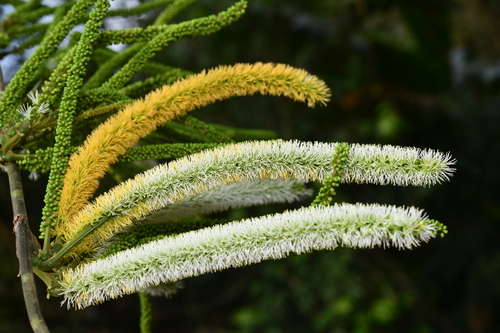
Entada phaseoloides (L.) Merr. is a large woody liana. Its stems can reach up to 18 cm (7.1 in) in diameter; they are dark brown with coarse bark, flattened laterally, and spirally twisted. Its bipinnate leaves grow up to 25 cm (9.8 in) long, with 1 to 2 pairs of leaflets, each of which is further divided into 1 to 2 pairs of pinnules (small leaflets). The pinnules are somewhat leathery, asymmetrical or oblique, and reach up to 10 cm (3.9 in) long by 5 cm (2.0 in) wide. Its inflorescences form spikes around 25–30 cm (9.8–11.8 in) long, which hold numerous sessile flowers. Individual flowers are very small, only about 1.2 mm (0.05 in) in diameter. They have five green petals with reddish bases, measuring about 3–4 mm (0.12–0.16 in) long, and stamens about 7 mm (0.28 in) long. In contrast to its tiny flowers, this species produces very large, flattened, woody pods as fruit. The pods measure about 1–1.2 m (3 ft 3 in – 3 ft 11 in) long and 12 cm (4.7 in) wide, are usually slightly curved along their length, and hold around 12 segments, each containing one seed. The seeds are lens-shaped, glossy brown, and smooth. They measure about 5–6 cm (2.0–2.4 in) wide and long, and 1–1.5 cm (0.39–0.59 in) thick. This species, commonly called matchbox bean, is native to a wide range spanning from mainland Asia through Melanesia to northern Australia and the western Pacific. Documented regions and countries where it is native include Tibet, south and southeast China, Japan, Mainland Southeast Asia, Malesia, Papuasia, northern Australia, New Caledonia, Vanuatu, Fiji, and Hawaii. Before commercial shampoos became widely available, Filipinos traditionally used gugo, the common local name for this species, to make shampoo. Shampoo is made by soaking and rubbing the bark of this vine, which produces a lather that effectively cleanses the scalp. Gugo is also used as an ingredient in hair tonics. Gugo contains saponin, triterpenes, and phenolic compounds. A study conducted by the Philippines Department of Science and Technology found that gugo prevents hair fall by stimulating microcirculation in scalp blood vessels. In Tonga, the seeds of this plant, called paʻanga, are used as ankle decorations for the traditional kailao dance, and also played in the ancient game lafo. Tonga’s current currency is also named after these seeds, paʻanga.