About Enicurus leschenaulti (Vieillot, 1818)
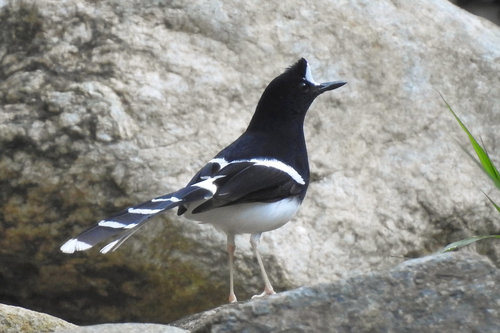
The white-crowned forktail (Enicurus leschenaulti) is the largest forktail species. It measures between 25 and 28 centimetres (9.8 and 11.0 inches) long, and typically weighs between 27 and 38 grams (0.95 and 1.34 ounces), though some specimens have weighed as much as 53 grams (1.9 ounces). It has black plumage on its face, throat that extends down to the breast, and scapulars. A prominent white patch covers its crown and forehead, which sometimes forms a slight crest and gives the species its common name. Its belly is white, with a sharp boundary separating it from the black throat and face. The lower back and rump are also white. This species has a long, evenly graduated tail with a deep fork; the tail has white tips, outer white feathers, and three narrower white bands formed by the tips of shorter tail feathers. Its wings are mostly black, with a prominent white band across the greater coverts. Juveniles have brownish black upperparts, breast, and throat, brown flanks, brown mottling on the belly, and lack the distinct white crown seen in adults. The species has a black bill and pinkish feet. Its solid black mantle distinguishes it from similar forktail species: the spotted forktail has a speckled mantle, the slaty-backed forktail has a slate-grey mantle, and it differs from the black-backed forktail by its longer tail and larger overall size. Six recognized subspecies differ slightly in size, bill length, tail length, and the extent of white on the crown: the Indian subspecies E. l. indicus has a slightly longer bill than the nominate subspecies E. l. leschenaulti; the Chinese subspecies E. l. sinensis has a slightly shorter bill than the nominate; the subspecies frontalis is smaller than other subspecies and has a smaller area of white on its crown; E. l. borneensis is similar to frontalis but has a longer tail; and E. l. chaseni is larger than other Sumatran birds and also has a longer tail. The species produces multiple distinct calls. Its alarm and contact calls are high-pitched, long, ringing whistles described as "tseee, tseee" or "zweeet", which are repeated multiple times with pauses between notes. The alarm call is harsher and more emphatic, described as "scree" or "scree chit chit". During display or territorial behavior, males produce a long, complex whistled song that often begins with a long fading whistle, followed by shorter whistles, clicking or chacking sounds, or bell-like notes. The calls of the borneensis subspecies differ slightly from those of other subspecies. The white-crowned forktail lives in subtropical or tropical moist lowland forests and moist broadleaf montane forests. Like other forktails, it frequents fast-flowing rivers, waterfalls, and streams within forests, though it moves to slower-moving water sources in winter. Its elevational range changes seasonally, and it likely makes seasonal migrations in northeastern parts of the Indian subcontinent; all records of the species from Bangladesh come from winter months. It also visits damp forest areas and pools, including animal wallows, swampy areas, and water ditches. In the lowland regions of its range, it may be found along slower-moving rivers and streams. It prefers areas covered by dense vegetation. On Borneo, the species is sometimes found in drier habitats, including along forest tracks and ridges, and in heathland. It has a wide geographic distribution across South and Southeast Asia, occurring in parts of India, Bangladesh, China, Myanmar, Bhutan, Thailand, Laos, Vietnam, Malaysia, and Indonesia. The species' elevational range varies across its distribution. In the Eastern Himalayas, it is generally found below 800 metres (2,600 ft) above sea level, though it occasionally occurs up to 1,250 metres (4,100 ft), and has been recorded exceptionally at 2,400 metres (7,900 ft) in Arunachal Pradesh. In Sumatra and Borneo, it is generally found up to 1,400 metres (4,600 ft) elevation. The subspecies borneensis occurs between 900–1,950 metres (2,950–6,400 ft), and occasionally as low as 185 metres (607 ft). The species is common across most of its range, but is uncommon in the Himalayas; in the Chinese portion of its range, it is reported to be the most common forktail. While the exact total population is unknown, it is thought to number more than 10,000 individuals and is estimated to be stable. The International Union for Conservation of Nature categorizes the species as least concern. Like other forktails, the white-crowned forktail stays close to water, and is frequently observed wagging its tail. It forages along stream edges and in the water, feeding primarily on insects including black beetles, water crickets, springtails, and caterpillars. It is described as a shy bird that flies close to the ground, usually calling while flying. It makes small seasonal shifts in its elevational range. It breeds between March and September, and possibly extends breeding into October; the breeding period varies slightly across its range. Eggs have been recorded as early as March in Borneo, and a parent with a fledgling was once recorded in February. It builds a large cup-shaped nest from moss, plant material, leaves, and wood fibre. The nest is usually located near or over water, and occasionally in nearby forest gullies. It is typically placed in a hole in a bank or cliff, or among tree roots; nests have also been found behind waterfalls, with the birds flying through falling water to reach the nest. Nests are always placed in damp locations. The species lays between two and five eggs per clutch, which are creamy, pinkish, or greyish white and covered in red-brown, salmon, and lilac speckles. Birds in southern China have been observed to raise two broods per year, and this pattern may occur elsewhere across the species' range. Clutch size varies with latitude, with individuals in China regularly laying four to five eggs. In Myanmar, nests of this species are known to be parasitized by the drongo cuckoo.