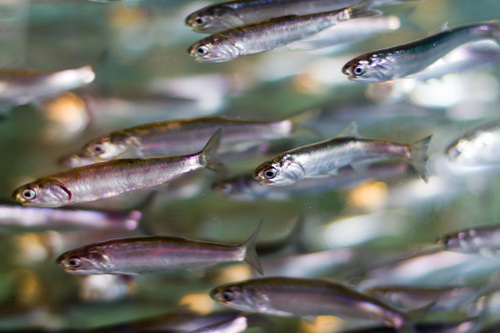
About Engraulis mordax Girard, 1854
Body Shape
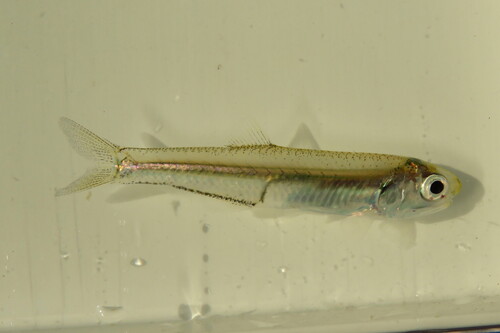
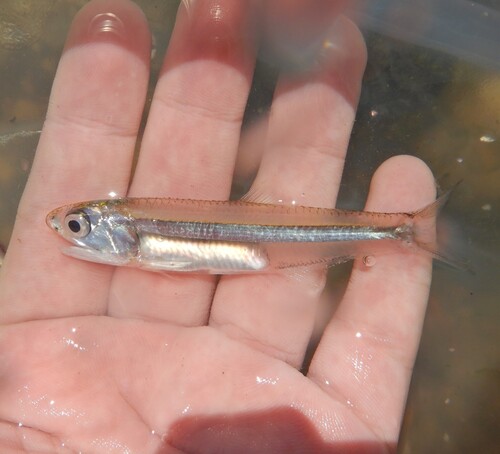
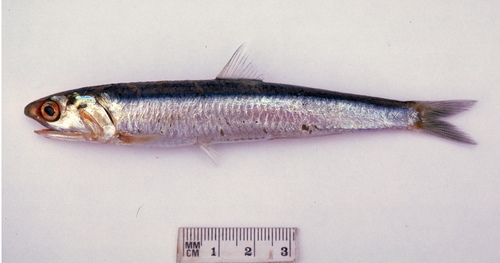
Morphology: Californian anchovies have the standard anchovy body shape. This includes a large sub-terminal mouth that extends past the eye, a single centrally positioned dorsal fin on a compressed, elongated body, and a forked caudal fin.
Scales and Camouflage
They have no visible lateral line, and bear weak, shiny scales colored by crystalline guanine that support their countershaded camouflage.
Species Distinction Trait
The only reliable way to distinguish Californian anchovies from European anchovies, outside of their different geographic ranges, is to check the termination point of the posterior side of the dorsal fin. For Californian anchovies, this point aligns vertically exactly with the start of the anal fin.
Native Range
Distribution: The native range of the Californian anchovy extends roughly from nearshore waters off Haida Gwaii in the north to the Gulf of California in the south.
Subpopulations
Three phenotypically distinct sub-populations make up this range: a northern subpopulation between British Columbia and Monterey Bay, a central subpopulation between San Francisco Bay and coastal waters near El Rosario in central Baja California, and a southern subpopulation from Cedros Island south into the mouth of the Gulf of California.
Subpopulation Taxonomic Status
While these subpopulations differ slightly in traits including operculum width, body size, transferrin pattern types, and spawning times, they are not genetically distinct enough to be reclassified as separate subspecies.
Hatching and Spawning Timing
Life cycle: Most California anchovies hatch from eggs in coastal waters or estuaries in late spring, though spawning can occur year-round.
Larval Habitat
Larvae live as ichthyoplankton in the photic zone near their hatching site, drifting with tidal and oceanic currents.
Larval Predation
Many are eaten by planktivores including Pacific herring and other anchovies.
Sub-adult Development and Habitat Shift
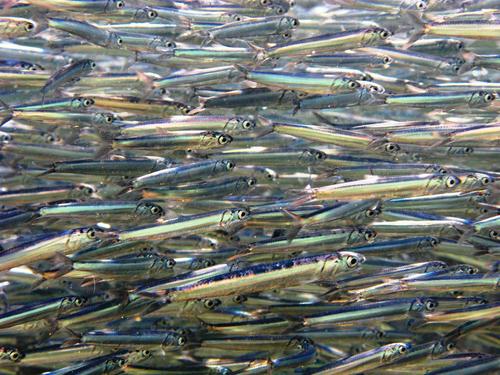
Surviving larvae mature into schooling sub-adults and move into more saline waters; this physiological shift is matched by an increase in guanine crystals in their chromatophores, which produces a bluer and greener dorsal color. Sub-adults eventually move into the open ocean to become adults.
Adult Diel Migration
Adult anchovy schools perform diel vertical migration, moving regularly between deeper and shallow waters to feed on plankton.
Spawning Habitat Trigger
When temperature and prey abundance cues trigger spawning, certain population cohorts move to spawn in shallow inshore waters or large estuaries like the Saline Sea or San Francisco Bay.
Lifespan and Reproduction Frequency
California anchovies typically live between 4 and 7 years, and reproduce every year after reaching maturity throughout their lives.