About Enemion biternatum Raf.
Taxonomic Identification
Enemion biternatum Raf. is a perennial herbaceous plant.
Growth Cycle
It produces evergreen basal leaves in the fall, and grows flower stems in the spring. After seeds ripen, the plant enters dormancy in late spring and early summer.
Leaf Architecture
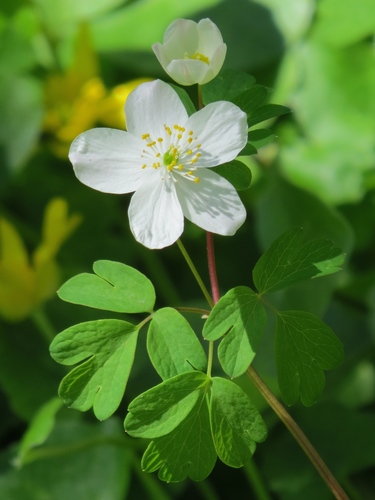
Its leaves are twice or thrice compound, arranged in groups of three leaflets. The leaflets have smooth margins, and are irregularly and deeply lobed two or three times, often with 1 to 3 additional shallow secondary lobes.
Leaf Stalk Characteristics
Basal leaves grow on long stalks, while alternately arranged leaves on the flowering stems have shorter stalks.
Stem Morphology
All stems are reddish in color and hairless.
Root System
The root system has weak rhizomes, and occasionally produces small tubers. Over time, plants spread to form dense colonies.
Stem Height
Flowering stems reach 4 to 16 inches (10 to 40 cm) in height.
Inflorescence Structure
Flowers are borne singly, or in leafy racemes holding 2 to 4 flowers; in this arrangement, leaves grow alternately along the stems, and flowers emerge from stems that arise from leaf axils. Two rounded stipules grow on either side of each leaf axil.
Sepal Morphology
Flowers have five white, petal-like sepals, each measuring 5.5–13.5 mm (3⁄16–9⁄16 in) long and 3.5–8.5 mm (1⁄8–5⁄16 in) wide.
Reproductive Floral Parts
Flowers also have 25 to 50 stamens with yellow pollen on their anthers, and 3 to 6 green carpels.
Fruit Development
When a carpel is fertilized, it develops into a beaked pod called a follicle. Once ripe, the pod splits open along one side to release several reddish-brown seeds.
Habitat Range
Habitats for this species include floodplain woods, limestone ledges, and rich or calcareous woods or thickets.
Floral Reward
Flowers of Enemion biternatum produce pollen but no nectar.
Flower Visitors
Small insects including sweat bees (genera Lasioglossum and Halictus), mining bees (genus Andrena), honeybees (Apis mellifera), and hoverflies visit the flowers to collect or feed on pollen. Some bees likely visit the flowers while searching unsuccessfully for nectar.