About Enceliopsis covillei (A.Nelson) S.F.Blake
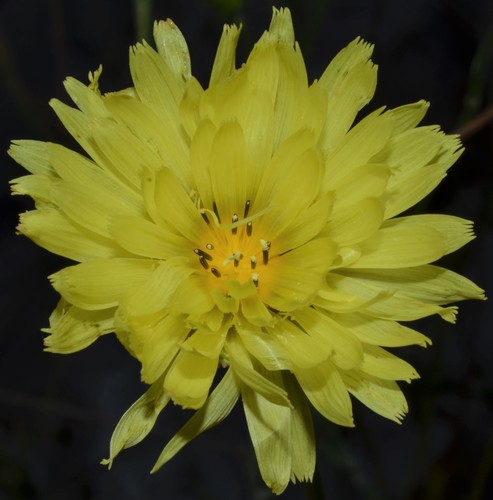
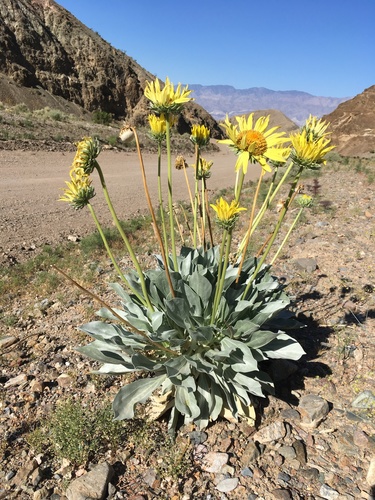
Enceliopsis covillei is a perennial herb that grows from a tough, woody caudex, and produces erect stems ranging from 15 to 100 cm (6 to 40 inches) in height. Its leaves are covered in silvery wool, are spade-shaped, oval, or diamond-shaped with winged petioles, and can grow up to 10 centimeters (4 inches) long by 8 centimeters wide. Its inflorescence is a large, solitary flower head that sits on an erect or leaning peduncle that may reach up to 100 cm (40 inches) tall. The base of the flower head is made of three layers of pointed phyllaries covered in gray or silvery hairs. The flower head has a fringe of many yellow ray florets, each up to 5 centimeters (2 inches) long, that surround many small disc florets of the same yellow color. Its fruit is an achene about one centimeter long with a small pappus. This perennial plant is endemic to California, where it occurs only within Death Valley National Park in Inyo County. It is known exclusively from the rocky slopes of the western Panamint Range sky island, located west of Death Valley in the northern Mojave Desert. The species was named for American botanist Frederick Vernon Coville (1867–1937) by American botanist Aven Nelson, who originally described it as Helianthella covillei.