About Encelia farinosa A.Gray ex Torr.
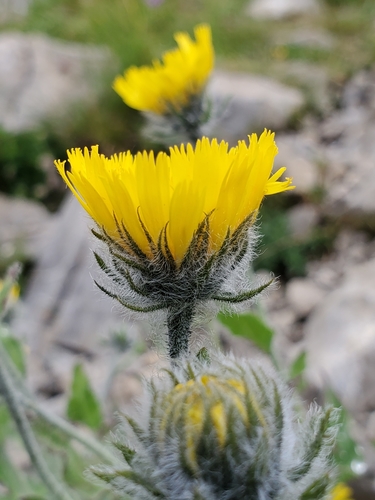
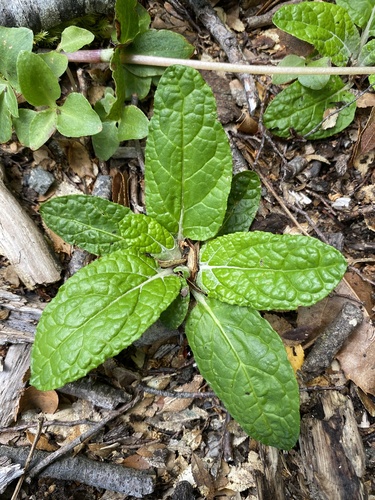
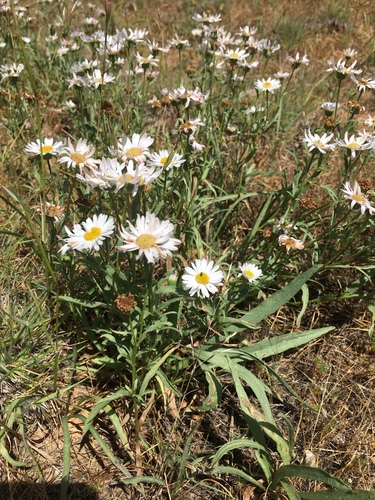
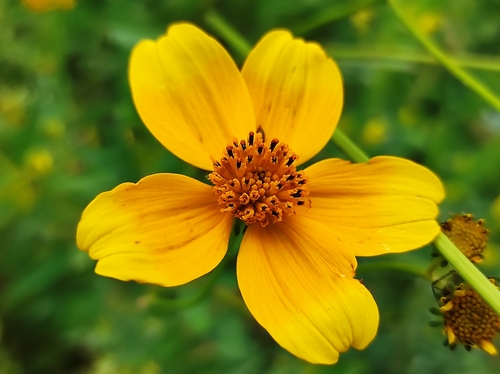
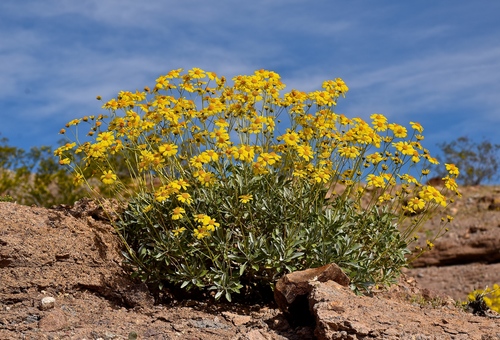
Brittlebush, scientifically known as Encelia farinosa A.Gray ex Torr., grows between 30 to 150 centimetres (12 to 59 inches) tall. It has fragrant leaves 3–10 cm (1+1⁄4–4 in) long, shaped ovate to deltoid, and covered in silvery hair-like tomentose fuzz. Its flower heads, called capitula, grow in loose panicles above the leafy stems and measure 3–3.5 cm (1+1⁄4–1+1⁄2 in) in diameter. Each capitulum holds 8–18 orange-yellow ray florets, 6–15 millimetres (1⁄4–9⁄16 in) in length, and yellow or purple-brown disc florets. The fruit of the plant is 3–6 mm (1⁄8–1⁄4 in) long, and it has no visible pappus. During dry seasons, this plant is drought deciduous, meaning it sheds all its foliage and survives using water stored in its thick stems. It is similar to Encelia californica, which differs by producing only one flower head per stalk. Encelia farinosa is common in the southwestern United States, specifically in California, Arizona, Utah, and Nevada, and in northern Mexico, specifically in Baja California, Baja California Sur, Sonora, Sinaloa, and Hidalgo. It grows in a variety of habitats, ranging from dry, gravelly slopes to open, sandy washes, up to 1,000 metres (3,300 feet) above sea level. It requires full sun, deep very well-drained soil, and is not tolerant of heavy winter frost. It grows well in cultivation, where it is often used for borders, erosion control, ground cover, and mass plantings. Recently, it has spread dramatically into areas outside its natural distribution, largely because the California Department of Transportation (Caltrans) began using it in hydroseeding projects. Brittlebush has a long history of traditional uses by indigenous peoples and pioneers, including the following. Yellowish to brown resin collected from the base of the plant can be heated and used as glue; the O'odham and Seri peoples use this resin for hafting, to secure points to arrows and harpoons. A distinct, more gummy generally clear yellow resin collected from the upper stems is used as a sealer; the Seri people use this resin to seal pottery vessels. Early Spanish friars found that the resin produces a highly fragrant incense, with an odor similar to frankincense. Children of the Tohono O'odham from the Sells area use upper stem resin as a serviceable chewing gum. Old-time cowboys used brittlebush stems as an effective toothbrush. For medicinal uses, the Seri people use brittlebush to treat toothache: they remove the bark, heat the branch in ashes, then place it in the mouth to harden a loose tooth. The Cahuilla people also used brittlebush to treat toothaches, and used it to relieve chest pain by heating the gum and applying it to the chest. It has also been used to waterproof containers and melted to use as varnish.