About Enallagma ebrium (Hagen, 1861)
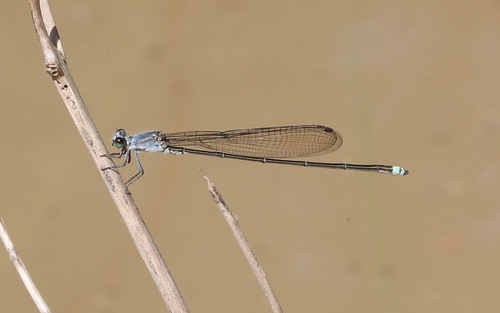
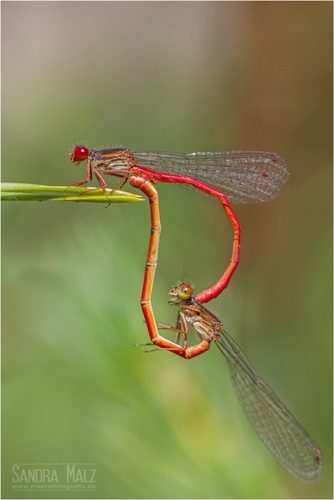
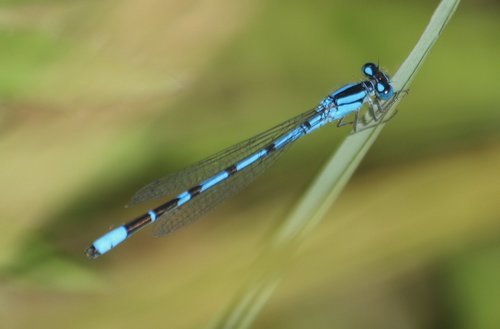
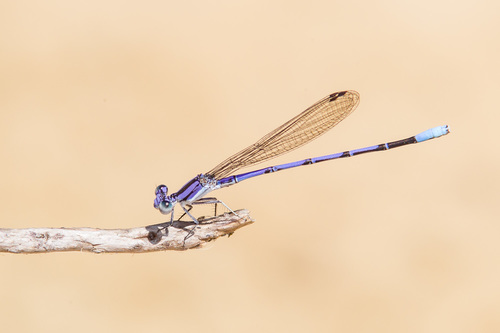
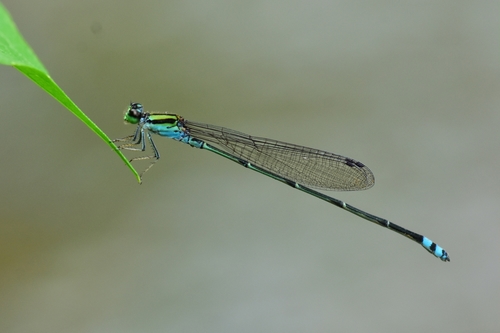
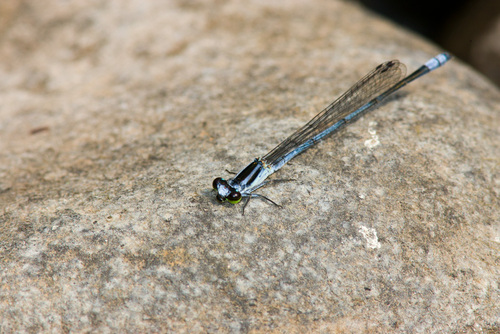
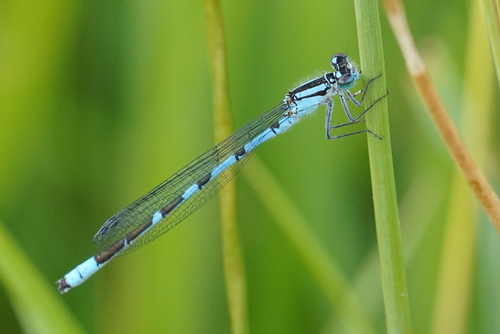
This species has the scientific name Enallagma ebrium (Hagen, 1861), commonly called the marsh bluet. For adult male marsh bluets: the thorax is blue, with a broad black stripe on the top and two black shoulder stripes. Their slender abdomen is mostly blue, with black marks along the top and a black tip. Their large eyes are dark blue-black, with small, tear-shaped postocular spots. For adult female marsh bluets: the pattern of markings on the thorax matches that of males, but the base color and markings are tan or blue-green and black, rather than blue and black. Their abdomen is mostly black on the upper side, and tan or blue-green on the lower side. Their large eyes are brown and yellowish. The aquatic naiad (immature stage) of this species is small, measuring around 16 to 20 mm (0.63 to 0.79 in) in length. It has the characteristic slender shape of an immature damselfly, and ranges in color from light to dark brown. Marsh bluets are typically found near lowland lakes, ponds, and marshes, and they have a clear preference for alkaline waters. This species is very common at alkaline marshes during mid-summer. Its known distribution covers the United States, including the states and territories of Colorado, Connecticut, Iowa, Idaho, Illinois, Indiana, Kentucky, Massachusetts, Maryland, Maine, Michigan, Minnesota, Montana, Nebraska, North Dakota, New Hampshire, New Jersey, Ohio, Pennsylvania, Rhode Island, South Dakota, Tennessee, U.S. Virgin Islands, Vermont, Washington, Wisconsin, and Wyoming; and Canada, including the provinces and territories of Alberta, British Columbia, Manitoba, New Brunswick, Northwest Territories, Nova Scotia, Ontario, Prince Edward Island, Quebec, and Saskatchewan. In terms of reproduction: males establish territories at preferred breeding sites. After mating between males and females, the female oviposits, or lays her eggs, either alone or while still paired in tandem with the male. The mating pair can descend as much as one foot under water to lay their eggs into aquatic vegetation.