About Empidonomus varius (Vieillot, 1818)
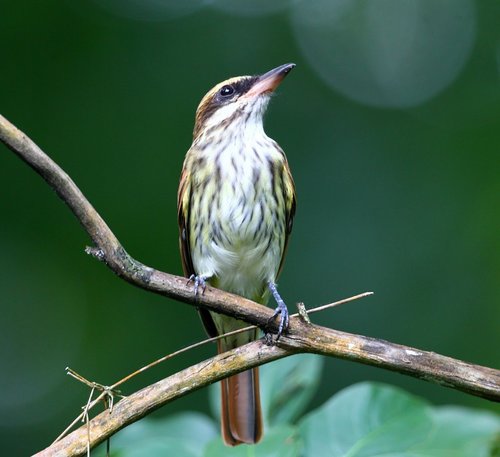
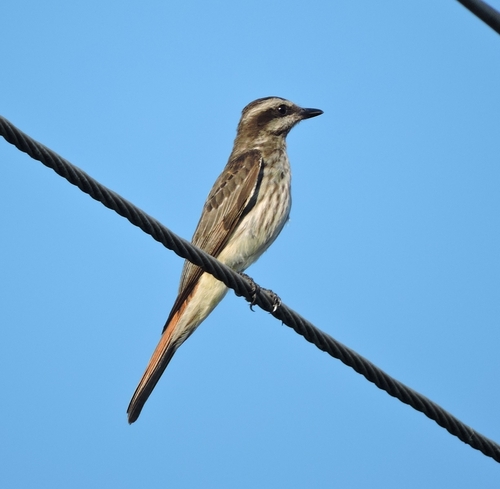
The variegated flycatcher (Empidonomus varius, first described by Vieillot in 1818) is 18 to 19 cm (7.1 to 7.5 in) long and weighs approximately 25 g (0.88 oz). Males and females have identical plumage. Adults of the nominate subspecies have a blackish or blackish-brown crown with a mostly hidden central yellow patch, a long white supercilium that extends almost all the way around the nape, a wide dusky band running from the lores to the ear coverts, and whitish cheeks marked by a dusky band below the cheeks. Their upperparts are mostly dusky or dark brownish, with pale whitish streaks that create a mottled overall appearance. Their rump is darker brown, with rufous edges on the feathers, and their uppertail coverts are rufous. Their tail is dark brown or blackish, with rufous feather edges. Their wings are dusky, with wide white edges on the coverts and flight feathers. Their throat is a dingy whitish color, and the rest of their underparts are yellowish white. Their breast and sides have indistinct darker streaks. The subspecies E. v. rufinus is smaller than the nominate subspecies, with paler, more brownish upperparts that have more olivaceous streaks, and less bold streaking on the underparts. Juveniles lack the yellow crown patch that adult birds have, and have unstreaked underparts. Both subspecies have a dark iris, a blackish bill with a pale pinkish base to the lower mandible, and black legs and feet. There are two recognized subspecies of variegated flycatcher, with E. v. rufinus occupying the more northerly range. E. v. rufinus is found on Trinidad, in the Venezuelan Andes and Venezuelan coastal mountains, and in southern and eastern Venezuela. Its range extends east from Venezuela through the Guianas and northern and eastern Brazil, reaching the Atlantic coast in Pará, stretching southeast to Bahia, and extending southwest almost to Bolivia. The nominate subspecies is found in southwestern Venezuela; eastern Colombia, Ecuador, and Peru; central and eastern Bolivia; central and southern Brazil; Paraguay; Uruguay; and northern Argentina, at least as far south as Entre Ríos Province. Additionally, the variegated flycatcher has been recorded in the U.S. states of Florida, Maine, Michigan, Tennessee, Texas, and Washington, as well as in Ontario, Canada. The variegated flycatcher lives in a range of somewhat open landscapes. These include primary forest edges, secondary forest, gallery forest, savanna with scattered shrubs and trees, large clearings, and sometimes parks. During migration, it can occasionally be found in the crown of unbroken terra firme forest. Its elevation range varies by region: from sea level to 1,200 m (3,900 ft) in Brazil, up to 400 m (1,300 ft) in Colombia, and up to 500 m (1,600 ft) in both Ecuador and Peru. In Venezuela, it reaches 1,900 m (6,200 ft) north of the Orinoco River, and 1,300 m (4,300 ft) south of the Orinoco.