About Empidonax wrightii S.F.Baird, 1858
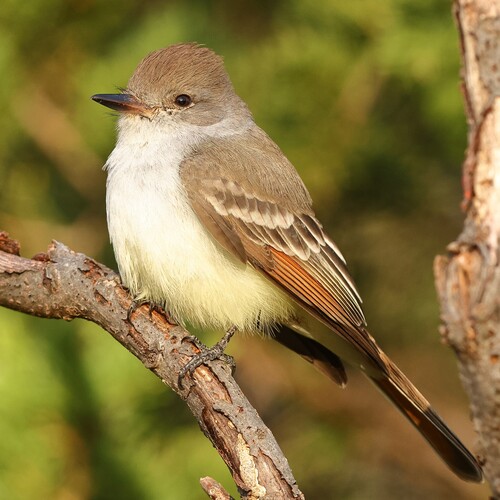
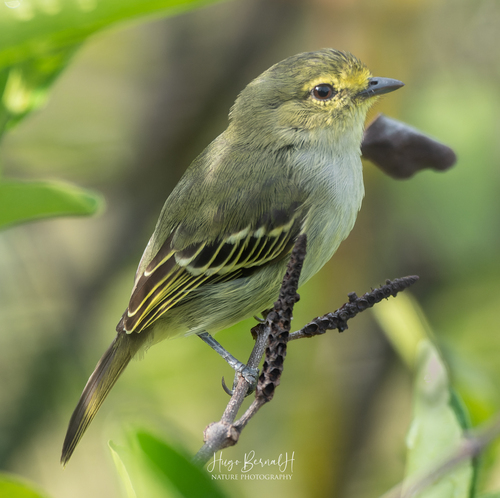
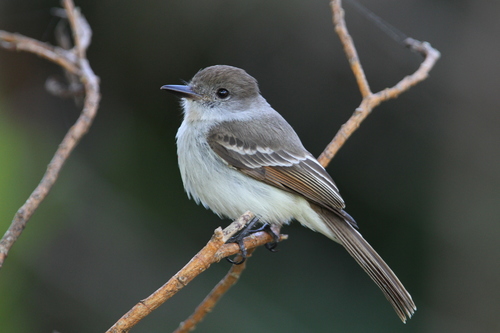
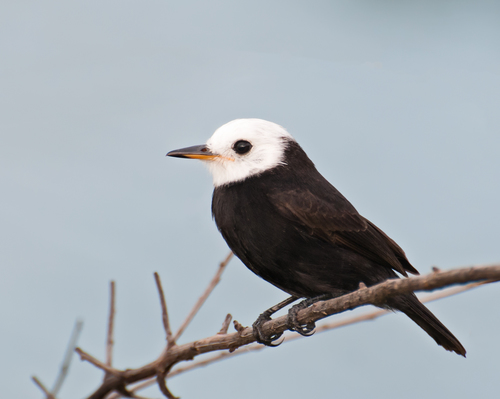
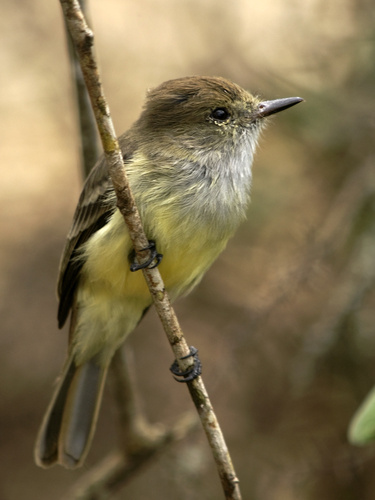
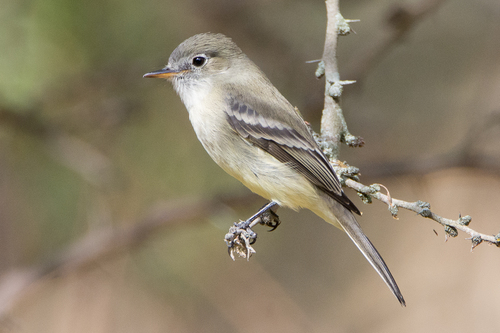
Empidonax wrightii S.F.Baird, 1858, commonly called the American gray flycatcher, is a small bird that is larger than most other species in the Empidonax genus. A typical adult is 15 cm (5.9 in) long, has a 22 cm (8.7 in) wingspan, and weighs 12.5 g (0.44 oz). Adult American gray flycatchers have pale gray upperparts that are darker on the wings and tail, with a faint olive tinge after fall molting. Their underparts are whitish, with a slight yellow wash when their plumage is fresh. They have white wing bars, an inconspicuous white eye ring, and a pale supraloral band that runs above the base of the bill. Compared to other North American Empidonax flycatchers, this species has a long, narrow bill, a long tail, and a lower mandible that is paler along most of its length. Juveniles look similar to adults, but have stronger olive and yellow coloration, plus buffy wing bars and brownish breasts. Only male American gray flycatchers sing; their song is a strong, two-syllable note described as chuwip or wilip, often with a weaker, higher-pitched teeap or seep inserted into it. Both sexes produce a dry pit or wit call, and females call frequently while foraging or collecting nest materials. The American gray flycatcher breeds from the southernmost point of British Columbia, through a narrow zone in central Washington, to eastern Oregon and California. Its breeding range extends east across Nevada, southern Idaho, Utah, and northern Arizona to southwestern Wyoming, western Colorado, and northwestern New Mexico. Depending on latitude, the species arrives on breeding grounds between mid-April and mid-May, and leaves between mid-August and mid-September. Migration between breeding and wintering grounds takes approximately seven weeks in both spring and autumn, and males usually arrive on breeding grounds one week earlier than females. The American gray flycatcher winters in Baja California Sur, southeastern Arizona, and central Sonora down to central Oaxaca. Small numbers may winter in western Texas and southern California. The species' breeding habitat includes shrubland, open woodland, or forest with a bare understory. Though this habitat is typically dominated by sagebrush (Artemisia species), common associated plant species include bitterbrush (Purshia species), rabbitbrush (Chrysothamnus species, Ericameria nauseosus), mountain-mahogany (Cercocarpus ledifolius), juniper (Juniperus species), pinyon pine (Pinus species), and ponderosa pine (Pinus ponderosa). During migration, the species generally uses habitat similar to breeding habitat, but often occupies riparian areas, so migrants may be found in areas with willow (Salix species), oak (Quercus species), or mesquite (Prosopis species). In winter, the American gray flycatcher lives in arid open and semiopen areas with scrub and scattered trees. American gray flycatchers are territorial during the breeding season. Males establish a territory and attract females via vocalizations and displays. The species appears to be monogamous, though extra-pair copulations may occur. The nest of the American gray flycatcher is bulky and less compact than nests of other Empidonax flycatchers. The female builds the nest, with males rarely helping, from various plant materials, especially grass stalks and strips of bark. The nest is usually lined with softer materials such as wool, hair, feathers, or soft grasses. Nests may be placed in sagebrush, bitterbrush, junipers, or pines. Nest height partially depends on the height of the substrate (nests tend to be higher in taller trees) and is usually 1–6 m (3.3–19.7 ft) above ground. Most nests are placed in the crotch of a branch next to the trunk, but some are located on larger branches away from the trunk. Females lay one egg per day, for a final clutch size of three or four eggs. The female incubates the eggs for about two weeks. Despite being laid on different days, the eggs usually all hatch on the same day. The chicks are altricial and have very little down when they hatch. Both parents feed the nestlings, and fledging occurs about 16 days after hatching.