About Empidonax traillii (Audubon, 1828)
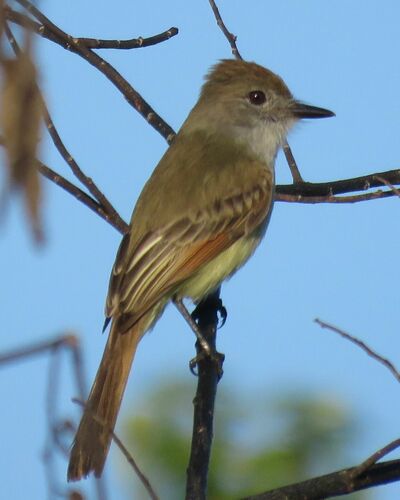
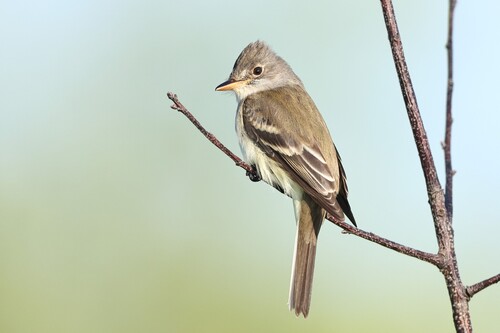
This species has the scientific name Empidonax traillii (Audubon, 1828), and is commonly called the willow flycatcher. Adult willow flycatchers have brown-olive upperparts that are darker on the wings and tail, paired with whitish underparts. They have an indistinct white eye ring, white wing bars, and a small bill. The breast shows an olive-gray wash, the upper portion of the bill is gray, and the lower portion is orangish. Their breeding habitat consists of deciduous thickets, especially willow stands, and is most often located near water across the United States and southern Canada. They build cup-shaped nests in vertical forks of shrubs or trees. These are neotropical migrants that travel to Mexico and Central America for the winter; small numbers reach as far south as Ecuador in South America, and they typically choose winter habitat near water. Willow flycatchers travel approximately 1,500 to 8,000 km (930 to 4,970 miles) one way between their wintering and breeding areas. The song of this bird is a sneezed 'fitz-bew', while its call is a dry 'whit'. Willow flycatchers are generalist insectivores, and the insects that make up their diet vary a great deal between different habitats. For example, in Ontario, Canada, flies from the order Diptera form the majority of the diet for adult willow flycatchers. In California, by contrast, Diptera only make up 10.6% of the flycatchers' diet; California willow flycatchers instead prefer Lepidopterans, mayflies, and snakeflies. They hunt as 'sit-and-wait' predators: they stay on a perch near the top of a shrub, then fly out to catch insects mid-flight. They have also been recorded gleaning insects off of leaves and stems.