About Empidonax hammondii (Xantus de Vesey, 1858)
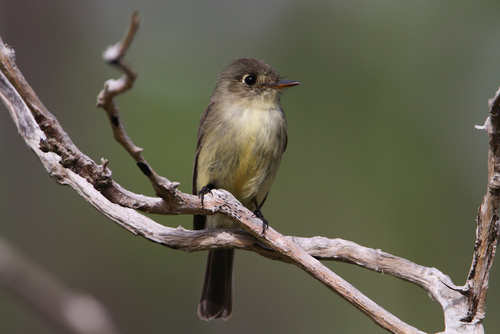
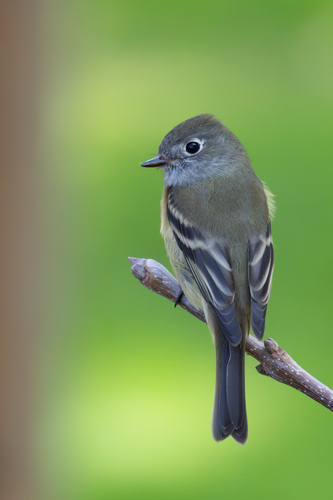
Adults of this species measure 12–14 cm (4.7–5.5 in) in length, have a wingspan of approximately 22 cm (8.7 in), and weigh 8–12 g (0.3–0.4 oz). Their upperparts are grayish-olive, darker on the wings and tail, with whitish underparts. They have a noticeable white eye ring, white wing bars, a small bill, and a short tail. The breast has a gray wash, and the sides of the belly have a yellow tint. Females typically have shorter, wider bills than males. Immature birds resemble adults, but they have broader wing bars and more buff coloration. Many species in the Empidonax genus of flycatchers look very similar to one another. Hammond's flycatchers are most often confused with Dusky flycatchers (E. oberholseri) and Gray flycatchers (E. wrightii), which match them in size and color and share overlapping ranges. The most reliable ways to distinguish Hammond's flycatcher are by its call, breeding habitat, and/or geographic range. This is a migratory species. It breeds in Western North America and winters in Mexico and Central America. Its preferred breeding habitat is mature coniferous and mixed forests, and it is typically found in dense fir forests, conifer and aspen forests, and dogwood stands. Habitats on its wintering grounds are similar to those it uses for breeding. During the breeding season, it can be found in the Western United States, including the states of Montana, Wyoming, California, Oregon, Nevada, Utah, Arizona, New Mexico and Colorado. In Canada, its breeding range covers British Columbia, Yukon and Alberta. Some individuals have been recorded as far north as Alaska. Overall, the breeding range of this species falls across regions heavily shaped by past glaciation events.