About Empidonax atriceps Salvin, 1870
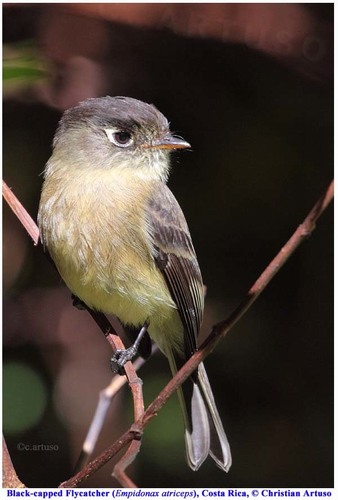
The black-capped flycatcher (Empidonax atriceps Salvin, 1870) measures 10 to 12 cm (3.9 to 4.7 in) in length and weighs approximately 9 g (0.32 oz). Males and females have identical plumage. Adult black-capped flycatchers have a black crown with a short crest, a prominent white eye-ring that is wider behind the eye, and an otherwise brownish olive face. These distinct markings alone separate this species from all other members of the genus Empidonax. The nape and upperparts are also brownish olive. The tail is dusky, with white outer webs on the outermost tail feathers. The wings are dusky, with pale brown edges along the secondaries and tertials. The wing coverts are dusky with pale brown tips, which form two distinct wing bars. The throat is white, while the breast and belly are pale buffish cinnamon. Adults have a dark iris, a black upper mandible (maxilla), an orange-yellow lower mandible (mandible) with a dark tip, and blackish legs and feet. Juveniles have a slightly duller black cap than adults, along with browner upperparts, buffy edges and tips on the wing feathers, and a paler belly. The black-capped flycatcher has a disjunct distribution. It occurs in Costa Rica in the Cordillera Central, the Dota Mountains, and the Cordillera de Talamanca. Its range extends along the Cordillera de Talamanca into the Chiriquí and Bocas del Toro provinces of western Panama. It primarily lives in primary and secondary montane evergreen forest in the upper subtropical and temperate zones, and also occurs in shrubby pastures. Most individuals are found between 2,100 and 3,300 m (6,900 to 10,800 ft) in elevation; the upper end of this range reaches the lower edge of the páramo zone. During the rainy season, the species can sometimes be found as low as 1,850 m (6,100 ft).