About Empidonax alnorum Brewster, 1895
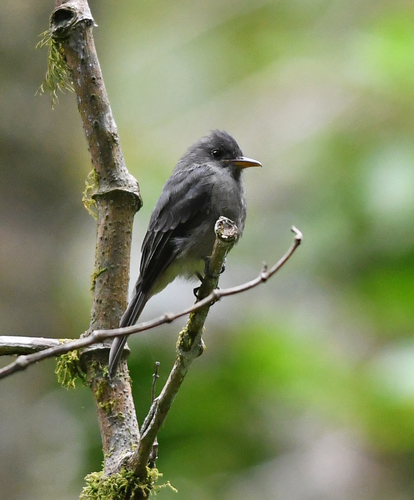
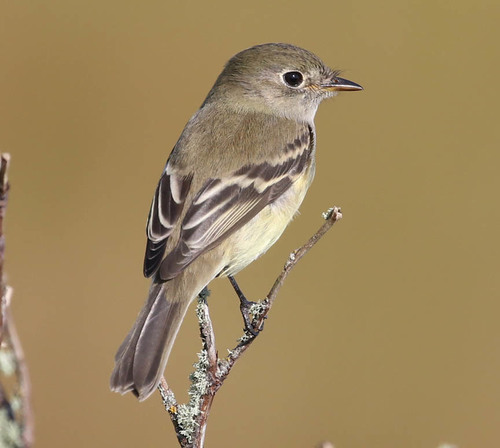
Empidonax alnorum, commonly known as the alder flycatcher, is one of the larger species in the Empidonax genus. Adults reach a length of 13–17 cm (5.1–6.7 in), weigh 12–14 g (0.42–0.49 oz), and have a wingspan of 21–24 cm (8.3–9.4 in). Adult upperparts are dull greenish-olive, with a crown that is slightly darker olive-green than the back. The throat is white, with a darker breast band. Thin white eye rings surround the eyes. The bill is wide and moderately long, with a pinkish or yellow-orange lower mandible and a black upper mandible. The wings are generally black, with white wing bars and white edges on the innermost secondaries (tertials). Juveniles have brownish upperparts, yellow underparts, and yellowish brown or buff wing bars. Alder flycatchers are similar in appearance to the eastern wood pewee (Contopus virens), the eastern phoebe (Sayornis phoebe), and the nearly identical willow flycatcher (Empidonax traillii), but can be distinguished by their smaller size and characteristic upward tail flicking behavior. Species within the Empidonax genus are notoriously difficult to identify. New methods have been developed to improve identification accuracy for mist-netted individuals, such as using ratios and differences between measured lengths of body parts including wings and beaks. In field identification when birds cannot be handled by hand, vocalizations are commonly relied upon. The ratio of primary feather lengths is useful for identification both for birds held in hand and in high-quality profile photographs. The alder flycatcher's summer breeding range covers most of Canada and Alaska, extending south to its southernmost point in the northeastern United States. In autumn, the species migrates south through the eastern United States, Mexico, and Central America, and winters in the western part of South America. During the summer breeding season, alder flycatchers live in wet, dense, shrubby thickets of young (typically 3–8 years old) alder (Alnus sp.), maple (Acer sp.), and birch (Betula sp.), at elevations from sea level up to 1,300 m (4,300 ft). During migration, the species occupies humid and semi-arid habitats including forest edges and fields, at elevations up to 2,500 m (8,200 ft). In winter, the species prefers early successional scrubby vegetation or woodland edges, especially those located near water and below 1,100 m (3,600 ft). Alder flycatchers breed in wet thickets of maple, alder, and birch. Nests are placed low in bushes within shrubby thickets; they are cup-shaped, built loosely from plant materials such as grass, weeds, pieces of bark, and small twigs. Strips of grass or bark can often be seen hanging from the bottom of the nest, and the interior is lined with soft materials such as plant down. Females do most of the nest building work. Male alder flycatchers vocalize to defend their breeding territories. Because the species has not been widely studied, courtship behavior is not confirmed, but it is thought to involve males chasing females through trees. Females lay three or four eggs per breeding season; the eggs are creamy-white or buff, and marked with dark speckles near the wider end. The female incubates the eggs for 12–14 days. Newly hatched chicks are altricial, and covered with tiny spots of olive-brown down. Both males and females take part in caring for the young. Juveniles make their first flight around 13–14 days after hatching.