About Empidonax albigularis P.L.Sclater & Salvin, 1859
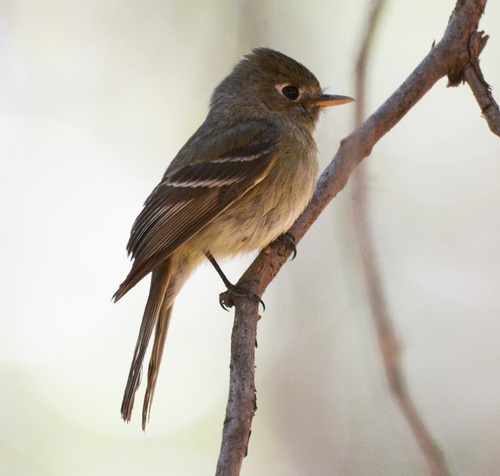
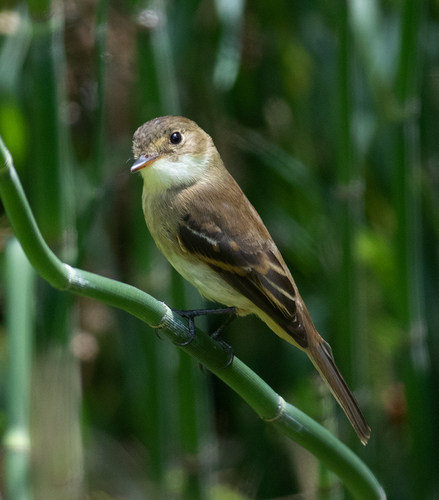
Empidonax albigularis, commonly called the white-throated flycatcher, measures 12 to 14 cm (4.7 to 5.5 in) in length. Three recorded individuals weighed between 10.4 and 11 g (0.37 to 0.39 oz). The sexes have identical plumage. Nominate subspecies adults have a brownish olive or olive brown crown, with dull buffy-white lores and eye-ring set against an otherwise paler brownish olive or olive brown face. Their upperparts are brownish olive or olive brown. Their tail is deep grayish brown, with light brownish olive coloring along feather edges. Their wings are mostly a darker grayish brown than their upperparts; the median and greater coverts have wide light buffy brown or brownish buff tips that form two prominent wing bars. The wing's secondaries have pale buffy grayish or grayish buff edges. Their chin and throat are dull white; their breast is buffy olive brownish, paler on the sides and flanks; their belly is pale buffy yellow or yellowish buff; and their undertail coverts are brownish buff. They have a dark brown iris, a black maxilla, a pink-orange or yellowish pink mandible that often has a dusky outer half, and blackish legs and feet. Immature birds have more brownish upperparts and more buffy underparts than adults, with cinnamon wing bars and pale buffy brown edges on the secondaries. Subspecies E. a. timidus is slightly larger than the nominate subspecies, with paler upperparts, less buffy wing bars, and brighter buffy-yellowish flanks. E. a. australis has slightly more olivaceous (less brown) upperparts than the nominate, with whiter lores, eye-ring, and wing bars, a less brownish breast, and yellower belly, flanks, and vent area. A comparative review of photos from the Macaulay Library across the species' range does not appear to support these reported phenotypic differences, so a taxonomic review of the species' subspecies may be needed. The white-throated flycatcher has a disjunct distribution. Subspecies E. a. timidus is found on the Pacific slope of western Mexico, from far southeastern Sonora and southwestern Chihuahua south to Morelos. The nominate subspecies has a wider range: it occurs on the Caribbean slope from southwestern Tamaulipas south through eastern and southern Mexico, and continues discontinuously south through Belize, Guatemala, El Salvador and Honduras. It may winter further south. E. a. australis is found discontinuously from Nicaragua south through Costa Rica into Chiriquí Province in western Panama. There are also scattered records of this subspecies further south in Panama, as far as the Canal Zone. During the breeding season, the white-throated flycatcher inhabits open and partially open landscapes in the subtropical and lower temperate zones. It is generally found near water, such as in wet meadows with brush or hedgerows, and in vegetation growing along streams and irrigation ditches. It also inhabits openings in higher elevation pine-oak forest. During the non-breeding season, part of the population moves to the tropical zone, where it favors freshwater marshes with tall rushes and weeds, and scrubby edges. In Mexico, the species occurs between 1,200 and 3,000 m (3,900 and 9,800 ft) in elevation during the breeding season, and between sea level and 1,200 m (3,900 ft) in the non-breeding season. In northern Central America, it breeds between 600 and 2,500 m (2,000 and 8,200 ft) and winters almost down to sea level. In Nicaragua it occurs between 1,000 and 1,500 m (3,300 and 4,900 ft), and in Costa Rica it mostly occurs between 500 and 1,500 m (1,600 and 4,900 ft).