About Empidonax affinis (Swainson, 1827)
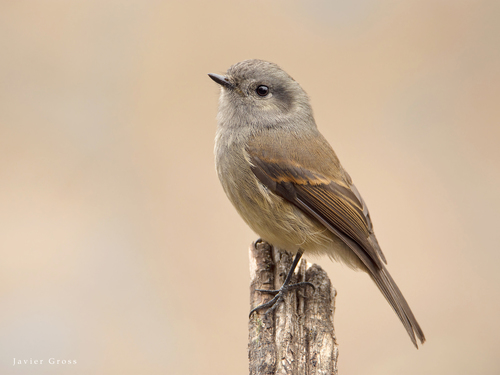
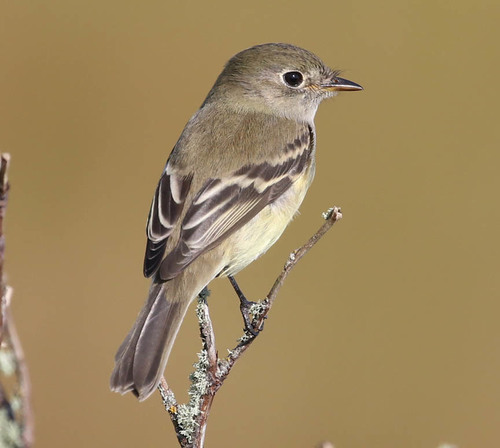
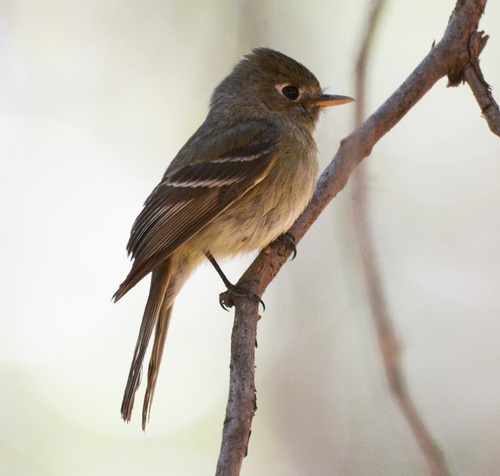
The pine flycatcher, whose scientific name is Empidonax affinis (Swainson, 1827), measures 13 to 14.5 cm (5.1 to 5.7 in) in length and weighs approximately 11.5 g (0.41 oz). Males and females are identical in appearance. Adults of the nominate subspecies E. a. affinis have pale grayish lores, a whitish tear-shaped eye-ring that tapers to a point behind the eye, and an otherwise olive to grayish olive head. Their upperparts are also olive to grayish olive. Their tail is dusky. Most of their wings are dusky, with whitish to buff tips on the coverts that form two distinct wing bars. The wing's secondaries and tertials have pale yellow edges. Their throat is pale grayish yellow, and their underparts are pale yellow with a gray or grayish olive wash across the breast. They have a dark iris, a black upper mandible (maxilla), an orange-yellow lower mandible, and blackish legs and feet. Juveniles have buffy wing bars. Other subspecies of the pine flycatcher differ from the nominate subspecies and from one another in the following ways: E. a. pulverius has the grayest back and breast of all subspecies; E. a. trepidus has a dark olive crown that contrasts with the lighter olive of its back; E. a. bairdi has slightly greener upperparts and slightly yellower underparts than the other subspecies; E. a. vigensis is duller than the nominate subspecies but matches it in all other features.
The pine flycatcher has a disjunct distribution, with each subspecies occupying a separate range. E. a. pulverius is found in northwestern Mexico, from southeastern Sonora and southwestern Chihuahua south to Jalisco. E. a. trepidus occurs from southeastern Coahuila to southwestern Tamaulipas in northeastern Mexico. The nominate subspecies E. a. affinis lives in central Mexico, from Michoacán south to Puebla. E. a. bairdi ranges from Guerrero, Oaxaca, and Chiapas in southern Mexico into western Guatemala. E. a. vigensis is restricted to west-central Veracruz in southeastern Mexico. A vagrant pine flycatcher found in the Santa Rita Mountains, Arizona, in late May 2016 marks the first recorded sighting of the species north of Mexico. An apparent 2009 record from Choke Canyon State Park in southern Texas was later reidentified as a least flycatcher (E. minimus). The pine flycatcher inhabits pine savanna, as well as the interior, edges, and openings of semi-arid to humid pine-oak forest. Across its overall range, it occurs at elevations between 1,500 and 3,500 m (4,900 and 11,500 ft); in Guatemala, its elevational range is between 1,750 and 3,350 m (5,700 and 11,000 ft).