About Empetrum nigrum L.
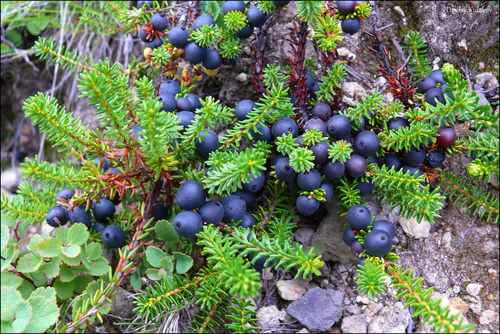
Empetrum nigrum L. is a low-growing, evergreen creeping shrub. Its leaves are 3–6 millimetres (1⁄8–1⁄4 inch) long, arranged alternately along stems. Young stems are red, fading to brown as they age, and grow slowly at around 7–15 cm (3–6 inches) per year. The plant forms thick clonal mats that prevent other plants from overgrowing it. It is usually dioecious, though a small number of individuals are bisexual with perfect flowers. Because the species is highly clonal, an entire patch may consist of a single sex. Flower buds of Empetrum nigrum begin developing the summer before opening, blooming the following May to June. The small 3–6 mm flowers have little to no scent, so they are not very noticeable. Flowers have 3 greenish-pink sepals that turn reddish purple, 3 petals, 3 stamens on male flowers, or a pistil with an ovary holding 6–9 ovules on female flowers. The round fruits are drupes 4–6 mm (1⁄8–1⁄4 in) wide. They are usually black or purplish-black, but are occasionally red, and contain an average of 7.8 seeds per fruit. Fruits are well-protected against pathogens, so they can persist through the entire winter. Fruits are on average 86.5% water; their dry weight contains 14.4% carbohydrates and 12.2% lipids, which may be the highest lipid content of any fleshy fruit in Europe. This species has a near circumboreal distribution in the Northern Hemisphere. It grows in bogs and other areas with acidic soils in shady, moist locations, and also grows in subalpine and alpine habitats in the Pacific Northwest. It can tolerate soils with a pH as low as 2.5, but cannot grow in basic soils with a pH greater than 8. Flowers of Empetrum nigrum are likely pollinated by a combination of generalist insects such as flies and beetles, plus wind. A range of animals including rodents, foxes, bears, caribou, and many bird species regularly consume its fruits and act as seed dispersers. Since the plant retains its fruits through winter into spring, it is an important food source for species like red-backed voles at a time of year when few other foods are available. Three moth species, Glacies coracina, Zygaena exulans, and Hadula melanopa, feed on this plant. Experiments with winter warming show that the metabolism and photosynthetic parameters of Empetrum can be altered. Empetrum nigrum has allelopathic properties, including hampering seed germination and root extension of other plants, though the strength of these effects depends on soil type. The plant's roots host ericoid mycorrhizal species from ascomycetes and basidiomycetes, which improve the plant's access to nitrogen and phosphorus. The fruit of Empetrum nigrum is edible, can be dried, and often has an acidic taste; in the Alaskan tundra, it is recorded to have a sweet and slightly tart flavor. It is frequently mixed with other berries for dishes like pies and puddings. It is abundant in Scandinavia, where it is valued for making liqueur, wine, juice, or jelly. In subarctic areas, it has long been an important part of the diet of the Inuit and Sami peoples. It is used to make Alaskan ice cream. The Dena'ina (Tanaina) people harvest the fruit for food, often storing large quantities for winter, and sometimes mix it with lard or oil. In the Canadian province of Newfoundland and Labrador, the berries, called "blackberries" locally, are used in jams, jellies, and baked goods such as buns, as well as puddings. In Labrador and northern regions of Newfoundland, entire plants are harvested, and their sods are used to add flavor to smoked fish. The species can also be grown as a ground cover, or as an ornamental plant in rock gardens, most notably the yellow-foliaged cultivar 'Lucia'. The fruit is high in anthocyanin pigment, so it can be used to produce a natural dye.