About Emberiza calandra Linnaeus, 1758
Common Name and Genus Placement
Emberiza calandra, commonly called the corn bunting, is an unusual member of the Emberiza bunting genus.
Sexual Dimorphism in Plumage
Unlike most species in this genus, males do not have bright, distinctive colors, especially on the head. Additionally, male and female corn buntings have similar plumage, though males are roughly 20% larger than females.
Body Size
This is a large, bulky bunting, measuring 16 to 19 cm in length.
Facial and Bill Features
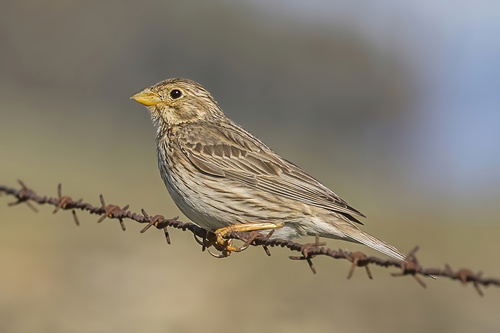
It has a noticeably dark eye and yellowish mandibles.
Overall Body Coloration
Both sexes resemble larks in appearance: they are streaked grey-brown on their upper bodies, with whitish underparts.
Underpart Markings
Streaking covers the breast and flanks of the underparts, and forms a collar-like gorget around the throat.
Wing and Tail Features
The lesser wing coverts have a distinctive dark base with white tips, and the tail is solid plain brown.
Male Song and Perching Behavior
The male’s song is a repetitive metallic sound, most often compared to the jangling of keys, and males sing from perches such as low bushes, fence posts, or telephone wires.
Breeding Range
This species breeds across southern and central Europe, north Africa, and Asia, extending east to Kazakhstan.
Movement Patterns
Most corn buntings are resident, but some populations from colder regions of central Europe and Asia migrate south for the winter.
Habitat Preferences
Corn buntings live in open country with scattered trees, including farmland and weedy wasteland.
Population Decline Cause
Populations have declined sharply in north-west Europe, because intensive agricultural practices have reduced the corn bunting’s food supply: weed seeds and insects, with insects being especially critical for feeding chicks.
Local Extinction Status
The species has recently become extinct in Wales and Ireland, where it was once common.
Diet Composition
Its natural diet is made up mostly of seeds, but it also eats insects like crickets, particularly when feeding young.