About Elymus lanceolatus (Scribn. & J.G.Sm.) Gould
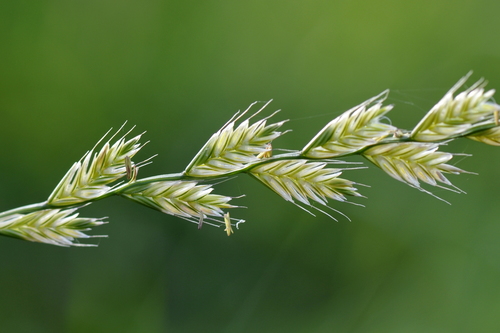
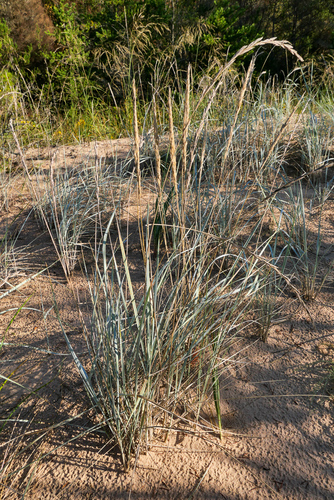
Elymus lanceolatus (Scribn. & J.G.Sm.) Gould is a grass that produces hollow, erect stems growing up to 1.3 metres (4.3 feet) tall. It grows from a dense, thickly intertwined network of roots and rhizomes that forms a sod. Its leaves are up to 25 centimetres (9.8 inches) long and 0.5 cm (0.20 in) wide, with flat or slightly rolled edges; in dry, hot weather, the leaves roll completely into cylindrical shapes. The inflorescence is a narrow, compact spike at the top of the stem, reaching up to 22 cm (8.7 in) long, and each spikelet can hold 2 to 11 flowers. This species is polymorphic, with two recognized subspecies: subsp. lanceolatus occurs across the entire species range, while subsp. psammophilus is found only in the Great Lakes region. It can hybridize with two other grass species: bluebunch wheatgrass (Pseudoroegneria spicata) and slender wheatgrass (Elymus trachycaulus). This plant is native to semiarid regions, growing in areas that receive 200-500 millimeters (8-20 inches) of annual precipitation. It is common and dominant across many habitat types at all stages of ecological succession, and can be found in forests, woodlands, sagebrush, shrubsteppe, desert, sandy lakeshores, sand dunes, and a wide variety of grassland and prairie ecosystems. It establishes easily in disturbed areas such as roadsides, and can grow at high altitudes in the Rocky Mountains as well as at sea level near the Great Lakes in the United States. While it rarely forms large monotypic stands, small pure stands of the species are common. It is highly drought-resistant, and tolerant of wildfire and grazing pressure. Its bloom period falls in mid-spring. It often reproduces by seed, though in some areas, particularly on sandy substrates, it reproduces vegetatively by sprouting from its rhizome. New plants also sprout from a soil seed bank, where seeds survive an average of 3 to 4 years. E. lanceolatus is a mycorrhizal species. Elymus lanceolatus has potential use for grassland restoration, which can indirectly benefit human food production by improving soil health, thanks to the dense sod formed by its root and rhizome network (a sod is grass held together by roots below the soil surface). This plant struggles to form rhizomes when neighboring roots create physical resistance, so its growth increases when nearby other plants are removed and it is planted at a moderate density of 300-600 seeds per square meter. This species, a type of wheatgrass, is specifically used for animal foraging. Like other wheatgrasses, it can be seeded with legumes in both warm and cool seasons, making it useful for forage. While it does not produce nuts or berries, it is consumed by grazing animals; in spring, it is a preferred food source for elk, horses, and cattle. It has a rapid vegetative spread rate despite a slow seed spread rate. Studies indicate it is inedible for human consumption, and the USDA Plants Profile notes it is not palatable to humans, so humans do not eat it. It does have medium protein nutritive potential: its protein levels peak at around 20% in spring, and decrease to about 4% as the plant matures. During its growth period, around 45% of its carbohydrates are digestible by animals. It makes good forage for livestock, especially when young and succulent, and can be used for foraging even in the summer when many other grass species have passed their peak nutritive and productive period. It is also consumed by wildlife such as elk. E. lanceolatus is valuable for revegetation of disturbed sites such as pipeline construction areas, and is useful for rangeland rehabilitation, as well as use in urban areas. Its ability to form thick sod makes it effective for erosion control, and the dense sod blocks invasion by most weeds. Several cultivars have been developed, including 'Bannock', 'Critana', 'Elbee', 'Schwendimar', 'Secar', and 'Sodar'. Both the species and its cultivars are effective at inhibiting the spread of invasive weeds including Russian knapweed (Acroptilon repens) and diffuse knapweed (Centaurea diffusa). Because it produces a dense mat of rhizomes, deep roots, and can form dense stands, it is well-suited for erosion control.