About Elophila nymphaeata Linnaeus, 1758
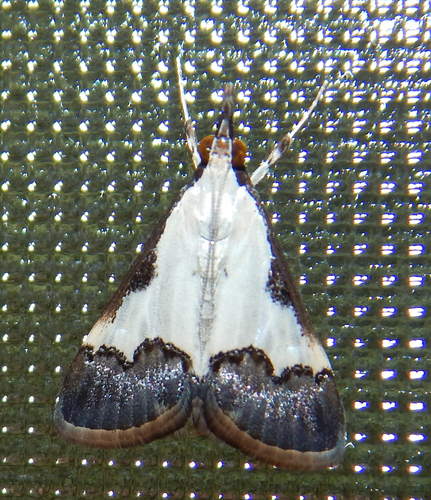
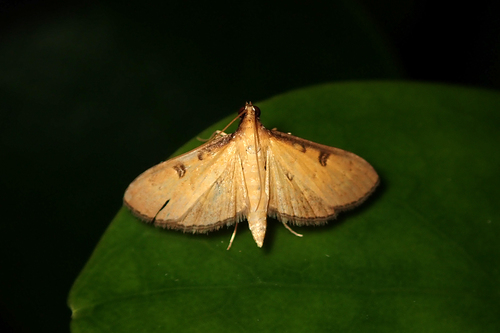
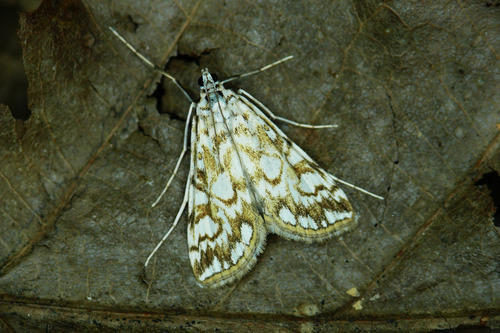
This species, Elophila nymphaeata Linnaeus, 1758, has a wingspan of 16–20 mm. Its forewings range in color from yellow-ochreous to fairly dark fuscous. The basal area features toothed white and dark fuscous lines, with a white subcostal spot located before the first line. The lines are whitish, obscure, and dark-margined; the first line is angled above the middle, while the second line has a deep, abrupt inward bend below the middle. The median band is almost entirely taken up by three white blotches that are edged with dark color. There is also an irregular, interrupted subterminal streak that is white, dark-edged, and dark-veined. The hindwings match the forewings in appearance, except their base is white, the median band is white except for the discal spot, and the second line is sinuate. The larva is light brownish, with a darker dorsal line, a light brown head, and a black-edged plate on the second segment. Larvae live inside flat, oval floating cases made of leaf fragments, and feed on plants such as Potamogeton, Hydrocharis, and Sparganium. Additional information can be found in Parsons et al. This species is distributed across Europe, through the Palearctic region, extending to the Russian Far East and China. This moth is notable because, like most species in the crambid subfamily Acentropinae, its larva is aquatic and possesses tracheal gills.