About Elkalyce argiades (Pallas, 1771)
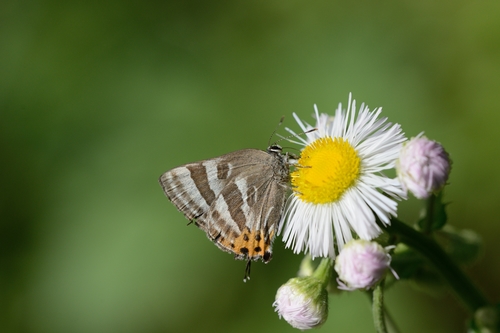
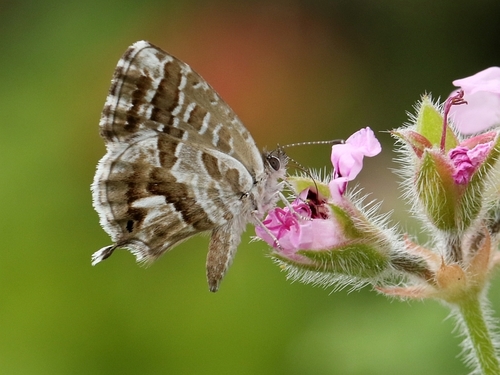
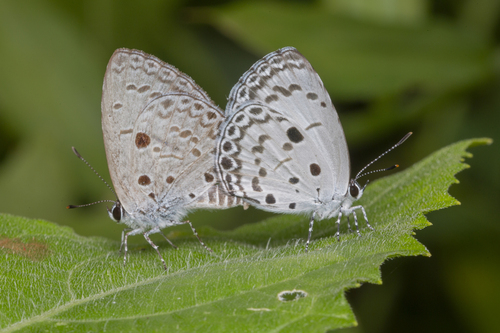
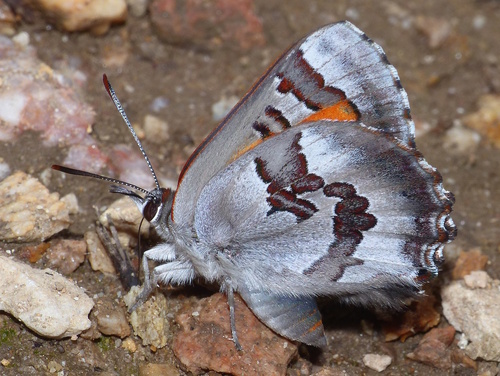
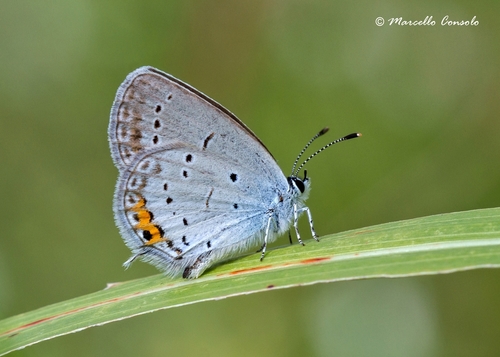
Elkalyce argiades (Pallas, 1771) shows clear sexual dimorphism in appearance. Males have a violet upperside: both the violet forewing and violet hindwing have brown edging, with the brown edging on the hindwing varying in length. All wings bear black spots, some of which have faint white edging. The tail is black with a white tip. The wing undersides range from white to brownish grey, and their markings can be either prominent or very faint. Antennae shafts are black with white speckling. The body is brown, and fresh male specimens have a purple flush over the brown base. Females have a dark grey-blue upperside with black areas and broader brown edging. Their wing undersides match the male's pattern, but have more distinct, stark markings. The female body matches the male's brown base color, but lacks the purple flush. Specimens collected from very dry sites in Upper Burma and Great Nicobar Island are unusually small and pale; their underside markings, especially the subtornal ochraceous yellow patch, are more or less completely gone. In the Palearctic realm, this species ranges from northern Spain eastward through Central, Southern, and Eastern Europe to Central Asia and Japan. It is absent from most of Italy, as well as southern Greece and southern Turkey. Across most of its range, adult butterflies fly from May to September, with flight timing varying by location. An isolated population in Southern Armenia begins flying in late April. In the Oriental realm, this butterfly is found in India. It inhabits areas from sea level up to around 1500 meters elevation, occurring in meadows, forest edges, woodland clearings, and glades that have sufficient flower cover. The larva is light green, with a dark stripe along its back, dark streaks along its sides, and scattered brownish and white spots. Larvae feed on a range of legume species, including Lotus uliginosus, Lotus corniculatus, Lotus pedunculatus, Securigera varia, Medicago sativa, Trifolium pratense, Astragalus glycyphyllos, and Ulex europaeus. The pupa matches the larva's light green color, or is darker than the larva, and is marked with black spots.