About Eleutherine bulbosa (Mill.) Urb.
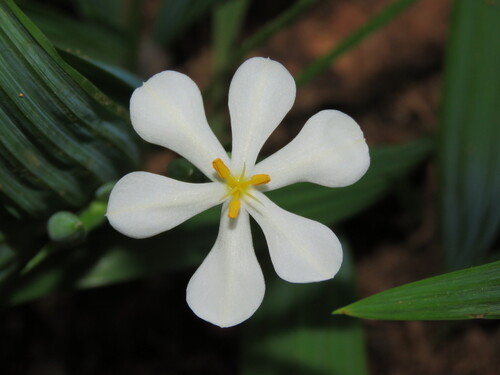
Eleutherine bulbosa (Mill.) Urb. is an herbaceous perennial flowering plant species belonging to the family Iridaceae. Among Spanish-speaking communities, it is commonly called lagrimas de la virgen, meaning "tears of the virgin". Like other species in the Eleutherine genus, E. bulbosa has a bulbous rootstock, one large subapical cauline leaf, and small, white, stellate flowers that bloom in the evening. Its natural distribution includes southern Mexico, the Amazon rainforest within the national borders of Peru, Bolivia, Ecuador, Guyana, Suriname, and French Guiana, as well as the Brazilian states of Amapá and Acre. This species is widely cultivated for its medicinal properties. Similar to E. latifolia, E. bulbosa has a basic chromosome number of x=6 (2n=12) and a shared bimodal karyotype. This karyotype is characteristic of the plant tribe Tigridieae, where all other genera in the tribe have a basic chromosome number of x=7. E. bulbosa typically carries a heteromorphic long chromosome pair, formed by a pericentric inversion in one of the long chromosomes, that causes sexual sterility in the species. In 1965, Rahenna described a subspecies of this plant: E. bulbosa subsp. citriodora.