About Eleocharis macrostachya Britton
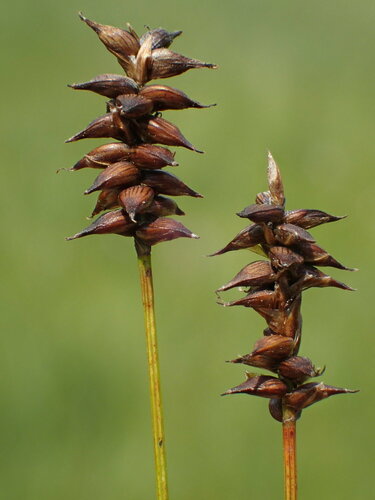
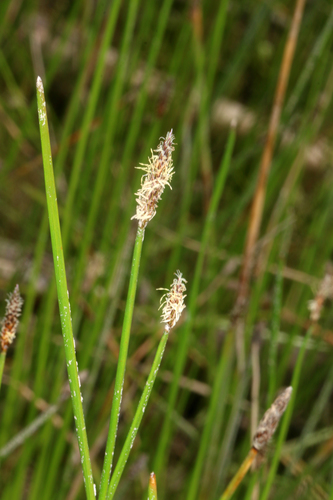
Eleocharis macrostachya Britton is a rhizomatous perennial spikesedge, commonly known as pale spikerush. It grows bright green erect stems, which typically reach heights of 0.5 to 1 meter, and have up to 25 vertical ribs. It forms colonies from long rhizomes. Its basal leaves are straw-colored and take the form of bladeless sheaths on the lower stem; the upper sheath is firm and often reddish toward the base. At the top of each stem is a narrow, lance-shaped or cylindrical inflorescence that holds a single spike 5 to 40 mm long. This spike contains 30 to 80 spirally arranged florets, each sitting under a 2 to 5.5 mm scale that is usually reddish or orange-brown. The lowest scale is sterile, meaning it does not contain a flower, and wraps around 75 to 100% of the stem; the second-lowest scale may or may not contain a flower. Each flower produces a single seed called an achene, which drops separately from its scale. Achenes are 1.1 to 1.9 mm long, yellowish to dark brown, with a distinct pyramidal tubercle 0.3 to 0.7 mm long at the tip. Tubercles are whitish to dark brown, and 1 to 2 millimeters long. Around each achene are 4 barbed bristles that are pale brown to whitish; these bristles may sometimes be absent. This species is widely distributed across North America, and also grows in parts of South America. It inhabits a variety of moist environments, including freshwater lakes, brackish marshes, ponds, ditches, vernal pools, and wet meadows. E. macrostachya has been studied for its roles in wetland restoration and in arsenic removal from groundwater via rhizofiltration, a phytoremediation process. Wetlands are able to remove many conventional contaminants from wastewater, even when the water is highly saline. A 2012 study by Olmos-Marquez found that E. macrostachya had the highest arsenic retention in an experimental wetland, indicating it acts as an effective rhizofiltrator.