About Elaphe schrenckii Strauch, 1873
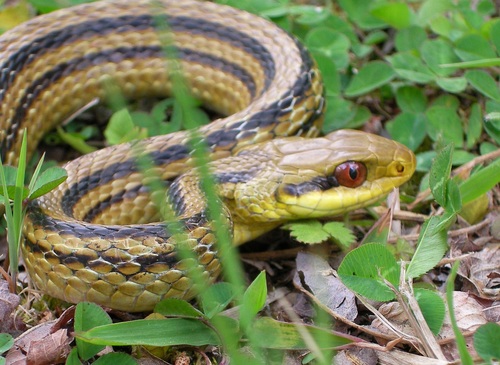
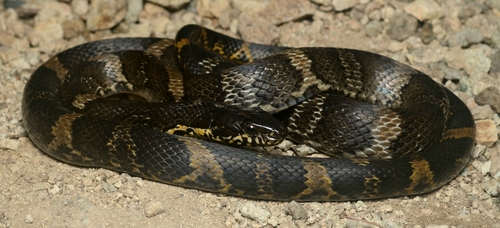
Elaphe schrenckii Strauch, 1873 (commonly called Russian rat snake or Manchurian black water snake) reaches an average total length (including the tail) of 1.2–1.6 m (3.9–5.2 ft). It is one of the most robust species among all rat snakes. Its coloration varies widely, with saddle-shaped markings ranging from cream to dark brown. Many captive-bred individuals have been selectively line-bred to produce uniform clean yellow saddles. The darker northern variety is the most common. This species has between 200 and 236 ventral scales, between 55 and 78 subcaudal scales, and between 21 and 23 rows of dorsal scales. It is endemic to Northeast Asia, and can be found in China, Korea, Mongolia, and Russia. Within Russia and China, its range extends east to Khabarovsk in the Amur region, west to the Chingan mountains, and north to Manchuria (Northeastern China). The common name 'Russian rat snake' is misleading, because only a small portion of the species' total geographic range lies within Russia. It has been recorded in the Chinese provinces of Jilin, Heilongjiang, and the Qingyuan area of Liaoning (Ji Daming et al., 1985). The species has also been introduced as an exotic population in the Netherlands, around Groningen airport near Eelde, where it was first observed in the mid-1990s. Reportedly, pet snakes were released into the wild by a person who did not expect the snakes to survive the winter. However, the snakes were hardier than anticipated, successfully bred, and the species is now gradually expanding its introduced range there. As the common name 'Manchurian black water snake' indicates, this species lives in fairly moist habitats including forest clearings, scrubland, and farmland. It hides in tree cavities, and among piles of stone or wood. When threatened, it can flee up trees or into water. Individuals of this species have been recorded as high as 6 m (20 ft) up in trees. It occurs at altitudes up to 2,000 m (6,600 ft), and can survive in cooler areas than many other snake species. For reproduction, adult female Elaphe schrenckii lay between 6 and 30 eggs in June or July. Females may retain their eggs for some time, so they are often deposited at a well-advanced stage of development. Eggs typically hatch within 40 days after being laid.