About Elaphe quatuorlineata Lacepede, 1789
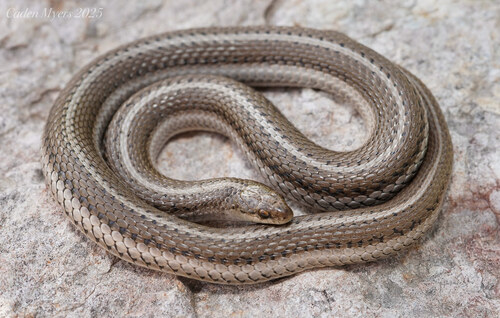
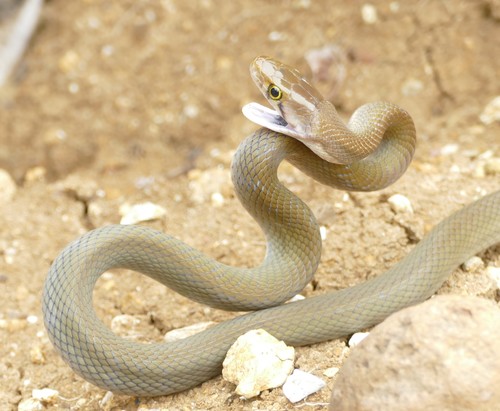
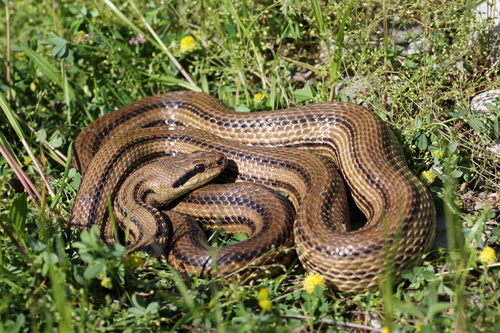
The species' common name refers to the markings on the bodies of adult four-lined snakes: four dark stripes running along a yellowish brown body. By contrast, juveniles have a dorsal series of dark brown blotches, with alternating dark brown spots on the sides, all over a pale brown background. A black line runs from the corner of the eye, and the belly is cream to white with darker markings. Adults can reach a length of 180 cm (5 ft 11 in), and rarely reach 200 cm (6 ft 7 in). Adults are among the heaviest snakes in Europe, but their size varies greatly. On the Aegean Islands, males can weigh between 250 to 1,000 g (0.6 to 2.2 lb), while females can weigh between 400 to 1,400 g (0.9 to 3.1 lb). Four-lined snakes are found in Italy, along the entire western coast of the Balkan peninsula, in the western half of Greece and many Greek islands, the region of Macedonia, the southwestern corner of Bulgaria, coastal Slovenia, coastal Croatia, Bosnia and Herzegovina, Montenegro, North Macedonia, and Albania. Total population size and population density of the species are currently unknown. The four-lined snake prefers areas with a Mediterranean climate, and lives in habitats that include vegetation, stone walls, sparse woodland, forest margins, and deserted buildings. In winter, individuals live communally in deserted rodent burrows, in groups of four to seven. Their general behavior is calmer than that of other snakes, and they rarely hiss or strike. They are usually active in the morning and late afternoon, and are excellent climbers that are often found in the tops of trees. The mating season for four-lined snakes runs from April to May. Females have a gestation period of around two months, and eggs are laid in summer. Females typically lay 6 to 18 eggs, which incubate for approximately 40 to 60 days before hatching.