About Elanus caeruleus (Desfontaines, 1789)
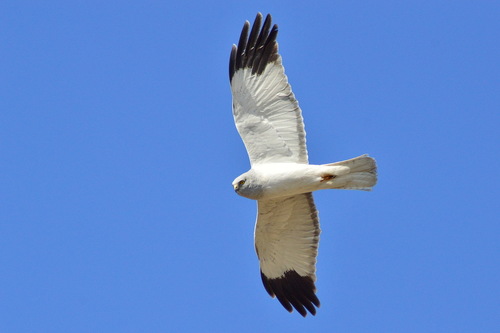
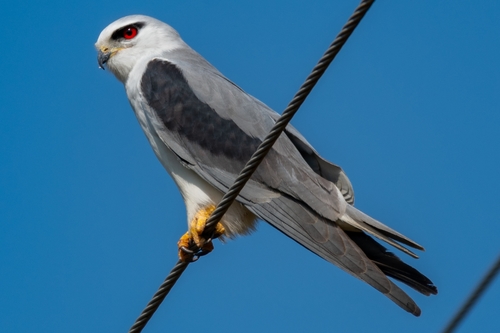
Elanus caeruleus, commonly called the black-winged kite, is a long-winged raptor. It is predominantly grey or white with distinct black shoulder patches, black wing tips and a black eye stripe. Its long falcon-like wings extend past the tail when the bird is perched. In flight, its short, square tail is visible and is not forked, unlike the tails of typical kites in the genus Milvus. When perched, often on roadside wires, it frequently adjusts its wings and jerks its tail up and down, likely to maintain balance. The sexes have identical plumage. Its distinctive features include large forward-facing eyes positioned under a bony shading shelf; velvety plumage and zygodactyl feet are traits it shares with owls, and the genus Elanus is considered a basal group within the Accipitridae family. This species is thought to be adapted for savanna habitats, where seasonal rodent population peaks occur, a food resource also favored by owls. The inner vanes of its feathers have velvety barbules. It has a diploid chromosome number of 68, though some older studies claimed 64 for the nominate subspecies E. c. caeruleus and 66 for E. c. vociferus. Its distinct karyotype resembles that of kites and honey buzzards, supporting its basal position among diurnal birds of prey. The black-winged kite occurs primarily in open land and semi-deserts of sub-Saharan Africa and tropical Asia, and also has established populations in southern Europe, specifically Spain and Portugal. The species' range is expanding in southern Europe, and more recently into West Asia. The first recorded breeding of the species in Europe was in the 1860s, and it has since become more widespread with increasing populations. Land-use changes, particularly the creation of agriculture and pastureland, are thought to have helped the species expand. Vagrants recorded in Switzerland and England indicate the species is continuing to move north. Several geographic populations are recognized as subspecies: the nominate subspecies E. c. caeruleus occurs in Spain, Africa and Arabia. The subspecies E. c. vociferus is found east of this range, across South Asia and into Southeast Asia. The subspecies E. c. hypoleucus (sometimes treated as a full separate species) ranges along Sumatra, Java, Borneo and the Philippines, and includes the population E. c. hypoleucus wahgiensis described from New Guinea. The subspecies sumatranus is not always recognized. The white-tailed kite and black-shouldered kite were formerly included within this species, but have since been reclassified as separate species. Though the black-winged kite is mainly found on plains, it has been observed at higher altitudes: up to 3,650 m (11,980 ft) in Sikkim, 2,670 m (8,760 ft) on Doddabetta in the Nilgiris, and 2,020 m (6,630 ft) in Nagaland. It is a winter visitor in some parts of its range such as the Western Ghats. Black-winged kites breed at different times of the year across their range. While nesting has been recorded throughout the year in India, they do not appear to breed in April and May. Males establish territories and defend them from competitors, and females move into the territories of males. Studies in Africa have found that males outnumber females. Courtship is noisy and involves chases, and once a pair forms they copulate frequently. The nest is a loose platform made of twigs, in which 3 or 4 eggs are laid. The female contributes more effort to nest construction than the male. The eggs are pale creamy with deep red spots. Both parents incubate the eggs, but after chicks hatch, the male spends more time foraging for food. The female initially feeds the young, sometimes hunting close to the nest, but also receives food from the male. After fledging, young birds remain dependent on the male parent for food for about 80 days; food is first transferred at a perch, and later in mid-air. Young birds have reddish brown feathers on their upperparts and breast. The reddish color comes from porphyrins and is thought to provide camouflage for young birds. After breeding is complete, females often move to new territories, sometimes deserting before the young fledge and leaving males to feed and raise the young. Both males and females are highly nomadic. Unlike most birds of prey, black-winged kites can raise multiple broods in a single year, and young birds disperse widely; these adaptations help them take advantage of periodic rodent population surges. Their opportunistic breeding is paired with irregular moult patterns. Young birds have "arrested" moult, retaining feathers for a season before rapidly moulting them in a serial descendent pattern, where more than one primary feather is moulted at the same time. They develop full adult plumage after two years. Prey of the black-winged kite includes grasshoppers, crickets and other large insects, lizards, and rodents. Injured birds, small snakes and frogs have also been recorded as prey. When hunting, the black-winged kite flies slowly like a harrier, but will also hover like a kestrel. It has rarely been recorded hunting prey in flight. It uses perches for hunting and feeding, but may handle large prey on the ground. In southern Africa, it prefers roadside verges for foraging, and is sometimes killed by collisions with vehicles. These birds roost communally, with groups of 15 to 35 individuals (larger groups have been recorded in Europe) gathering at a large leafy tree. They are extremely silent; recorded calls include a high-pitched squeal or a soft whistle, and they call mainly during the breeding season and at the roost site. Several parasites have been recorded from this species: the nematode Physaloptera acuticauda in South Africa, the trematode Neodiplostomum elani (with the black-winged kite as its type host) from Chandigarh, and the feather louse Degeeriella elani. The soft feathers of black-winged kites can catch some grass seeds, which may be dispersed by the bird, but these seeds can also pose a risk of entangling the bird's wings.