About Elaenia parvirostris Pelzeln, 1868
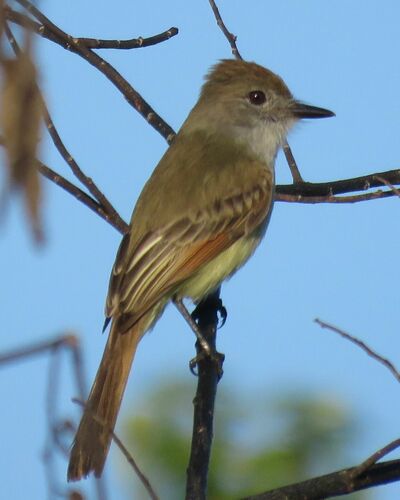
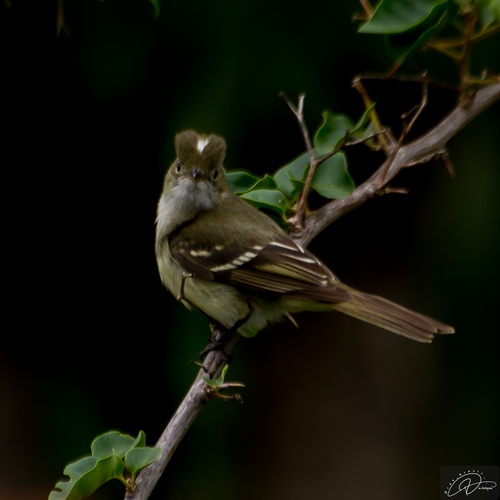
The small-billed elaenia (scientific name Elaenia parvirostris Pelzeln, 1868) measures 13 to 15 cm (5.1 to 5.9 in) in length. It is a small elaenia that lacks a crest, and males and females have identical plumage. Adult small-billed elaenias have a bright olive-green crown with a partially visible white central stripe, whitish lores, and a thin but distinct white eyering. Their upperparts are bright olive-green. Their wings are dusky, with whitish tips on the coverts that form three distinct wing bars, and their flight feathers have narrow whitish edges. Their tail is dusky. Their throat is gray, their breast is a slightly darker gray that sometimes has an olive wash, and their belly and undertail coverts are whitish. Both sexes have a dark brown iris, a black bill with a dull pinkish base to the lower mandible, and black legs and feet. The small-billed elaenia breeds in eastern and southeastern Bolivia, most of Paraguay, Brazil from São Paulo state south through Rio Grande do Sul, all of Uruguay, and northeastern Argentina as far south as central Buenos Aires Province, extending somewhat further south along the coast. During the austral winter, it migrates north to the western half of Brazil, northern Bolivia, the area east of the Andes in Peru, Ecuador, Colombia, and Venezuela, the Guianas, Aruba, and Trinidad. It has been recorded as a vagrant twice in Illinois, once in Texas, and once in Quebec; it has not been recorded in Mexico, Central America, or the Caribbean outside of South American coastal islands, though one individual was observed in Florida in 2025. Within its breeding range, the small-billed elaenia lives in somewhat open landscapes, including forest and woodland edges and openings, riparian forest, secondary forest, taller shrublands, parks, and gardens. During the austral winter, it also occupies most of these same landscapes, and additionally uses savanna, the canopy of humid forest, and river islands.