About Elaenia martinica (Linnaeus, 1766)
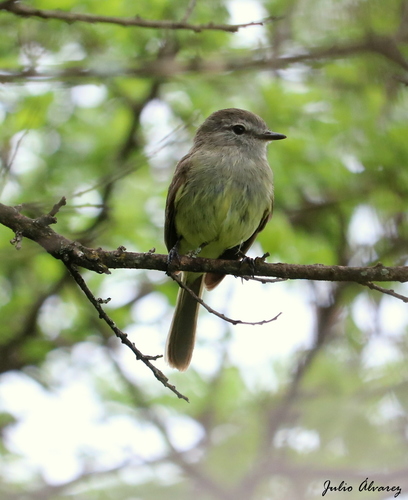
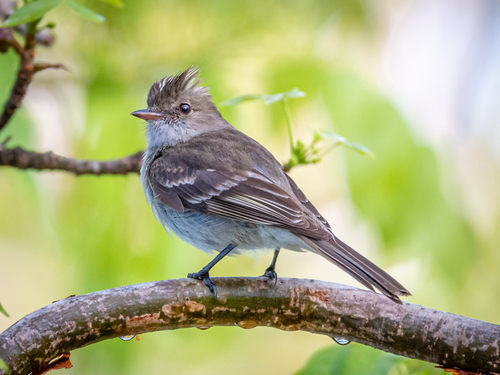
The Caribbean elaenia, Elaenia martinica, measures 14 to 18 cm (5.5 to 7.1 in) in length and weighs 18 to 29 g (0.63 to 1.0 oz). It is a largish elaenia with a bushy crest, and both sexes have identical plumage. Adults of the nominate subspecies E. m. martinica have a dull olive to brownish olive crown with a white stripe running down the middle of the crest. Their face is mostly mottled gray-brown, with whitish lores and a faint whitish eyering. Their upperparts are dull olive to brownish olive. Their wings are dusky, with yellowish to whitish edges on the flight feathers and yellowish to whitish tips on the coverts; the tipped coverts form two distinct wing bars. Their tail is dusky. Their throat is sooty gray, their breast is pale gray, their belly ranges from whitish to dull yellowish, and their undertail coverts are yellowish to whitish. The other recognized subspecies differ from the nominate and from each other as follows: E. m. riisii is smaller and overall paler than the nominate; E. m. barbadensis is larger than the nominate and has darker underparts; E. m. remota is smaller than the nominate, with a browner rump and grayer throat and breast; E. m. chinchorrensis has dark brownish upperparts (less greenish olive than the nominate) and no yellow on the belly; E. m. cinerescens is larger than the nominate with a stronger yellow wash on the belly; E. m. caymanensis is intermediate in size between riisii and the nominate, and is overall paler than the nominate. Both sexes of all subspecies have a dark brown iris, a black bill with a dusky pinkish base to the lower mandible, and black legs and feet. Subspecies of the Caribbean elaenia have the following distribution: E. m. riisii occurs in Puerto Rico and its offshore islands, the Virgin Islands, Anguilla, St. Martin, St. Bartholomew, Antigua, Barbuda, and Aruba, Bonaire, and Curaçao in the Netherlands Antilles. A bird that is possibly E. m. riisii has been photographed and audio recorded as a vagrant in northwestern Florida, though identification is not definitive; the Florida Ornithological Society lists it only as "Elaenia species". E. m. martinica occurs in the Lesser Antilles from Saba and St. Eustatius south to Grenada. E. m. barbadensis occurs on Barbados. E. m. remota occurs on Culebra Cay and the islands of Cozumel, Holbox, Meco, and Mujeres in Quintana Roo, southeastern Mexico. E. m. chinchorrensis occurs on Great Cay Island off Quintana Roo, Mexico, and on Half Moon Caye, Middle Caye, Glover's Reef, Caye Caulker, and Ambergris Caye off Belize; it has also been recorded as a vagrant on the Belizean mainland. The Clements taxonomy notes that the population on the Belizean cayes may instead belong to E. m. remota. E. m. cinerescens occurs on San Andrés, Providéncia, and Santa Catalina islands, which lie east of Nicaragua. This archipelago is a department of Colombia, but it is closer to Nicaragua than to mainland Colombia. Different taxonomic systems vary in their treatment of this population: Clements taxonomy assigns it to E. m. cinerescens but incorrectly places the archipelago "east of Honduras"; a second taxonomic system does not name the archipelago and places E. m. cinerescens on "islands off Honduras"; a third system places this archipelago's population in the "Caribbean" group without assigning it to a named subspecies. E. m. caymanensis occurs on the Cayman Islands. The Caribbean elaenia occupies most lowland landscapes across its range. It can be found in the canopy and at the edges of humid evergreen forest, in deciduous woodland, scrublands, parks and gardens, open land with scattered trees and shrubs, and in coastal mangroves. It also occurs in the mountains of the southern Lesser Antilles. In elevation, it ranges from sea level to approximately 700 m (2,300 ft).