About Elaenia chiriquensis Lawrence, 1865
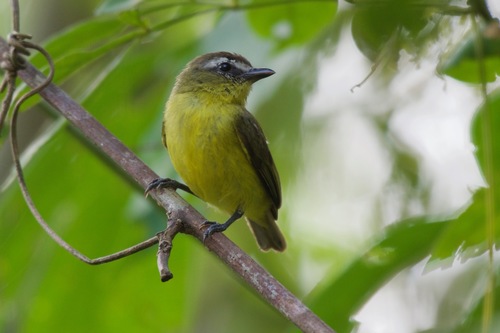
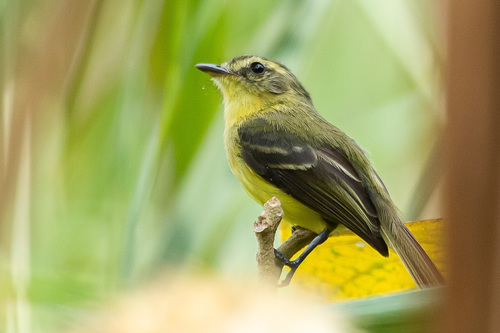
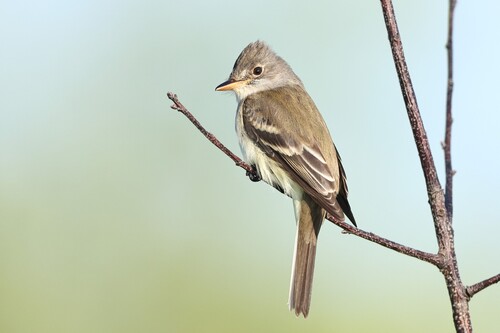
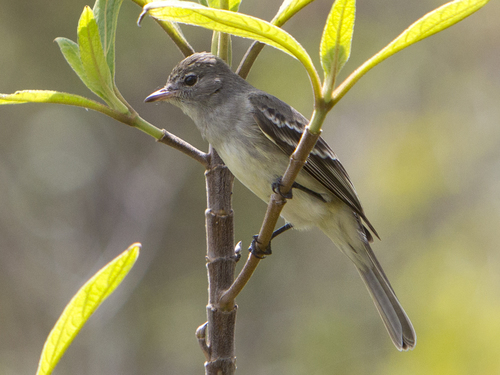
Lesser elaenia, with the scientific name Elaenia chiriquensis Lawrence, 1865, measures 13 to 14 cm (5.1 to 5.5 in) long and weighs 11.5 to 22 g (0.41 to 0.78 oz). It is a small elaenia with a small squarish crest, and males and females share identical plumage. Adults of the nominate subspecies have a grayish olive head with lighter cheeks, a thin whitish eyering, and a partially hidden white crown patch. Their upperparts are grayish olive. Their wings are mostly dusky, with whitish edges on the flight feathers; the tips of the coverts are white, forming two wide bars on the closed wing. Their tail is dusky. Their throat is gray, their breast grayish olive, and their belly and undertail coverts pale yellow. Subspecies E. c. albivertex has paler underparts than the nominate subspecies and is otherwise identical to it. Individuals of both sexes and both subspecies have a dark brown iris, a black bill with a pinkish base to the mandible, and black legs and feet. The lesser elaenia has a highly disjunct distribution. The nominate subspecies occurs in scattered locations in inland Costa Rica, along the Pacific slope from Costa Rica's San José Province south through Panama to the Canal Zone, on Panama's Caribbean side in Colón Province, and on Coiba Island and the Pearl Islands off Panama's Pacific coast. Subspecies E. c. albivertex is found in northern, central, and eastern Colombia; western and eastern Venezuela; Trinidad; the Guianas; extreme southeastern Ecuador, which continues south along the eastern side of the Andes into Peru as far as the Department of Junín; a few other isolated locations in Peru; across northern Bolivia; eastern Paraguay; separate areas in far northern and northeastern Argentina; and in Brazil, across a band across the country's north, south through eastern Amazonia, across south-central Brazil, and along most of the southeastern Brazilian coast. E. c. albivertex has been recorded as a vagrant on Bonaire and Curaçao. This species lives in a variety of open and semi-open tropical zone landscapes, including scrublands, cerrado, light woodlands, secondary forest, brushy areas along watercourses, savanna grasslands with scattered shrubs and trees, plantations, and hedgerows in cultivated areas. In elevation, it reaches 1,750 m (5,700 ft) in Central America, 2,000 m (6,600 ft) in Colombia, 3,000 m (9,800 ft) in Venezuela, and 2,000 m (6,600 ft) in Brazil.