About Elaeagnus pungens Thunb.
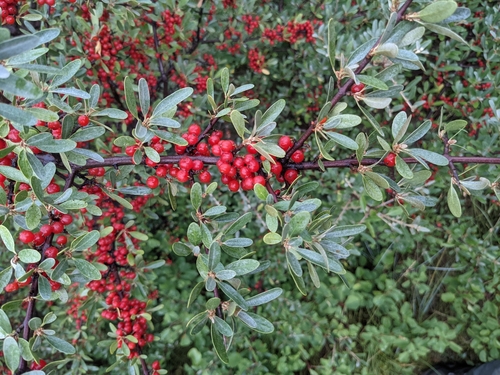
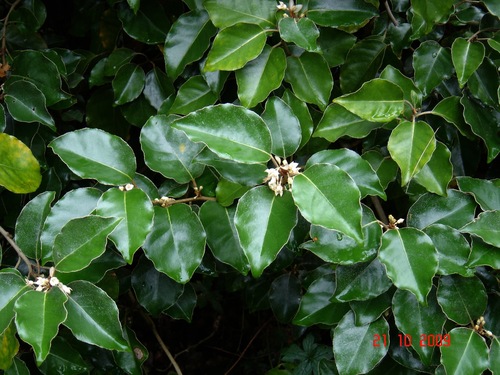
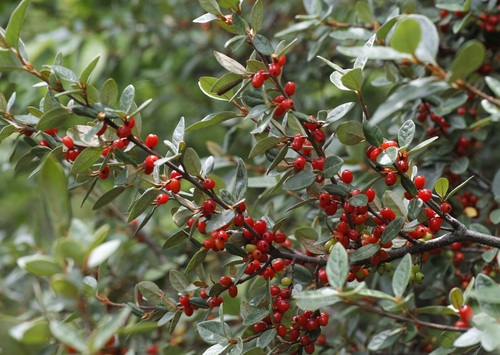
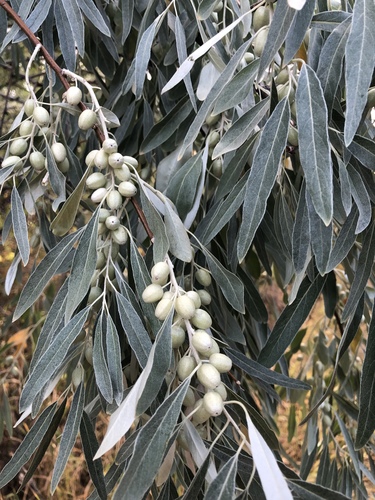
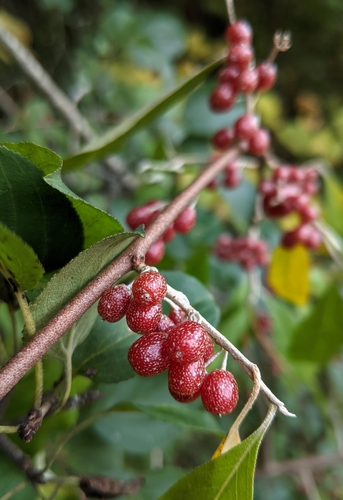
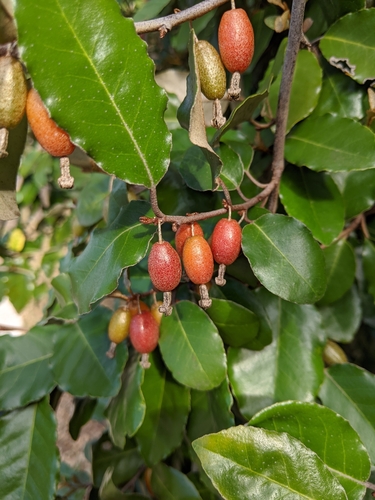
Elaeagnus pungens Thunb. is a dense, branching shrub that can grow over 7 metres (23 ft) tall and 4 metres (13 ft) wide. It sprouts prolifically from its stem, spreading out and twining into adjacent vegetation. Parts of the stem are covered in thorns that can reach up to 8 centimetres (3.1 in) long. Its evergreen leaves are alternately arranged, growing up to 10 centimetres (3.9 in) long and under 5 centimetres (2.0 in) wide. The undersides of the leaves are silvery white with brown flecks. Tubular yellowish or white sweet-scented flowers grow in clusters of up to three. The fruit is a reddish drupe covered in silver scales, up to 1.5 centimetres (0.59 in) long, containing a single seed. This species blooms in autumn, and its fruit develops during spring. It grows quickly, producing shoots over one meter per growing season; its growth has been described as "aggressive", with shoots extending many meters into neighboring treetops. Its seeds are dispersed by birds. In its native range, this plant occurs on hillsides and in thickets in China, and grows in scrub dominated by Quercus phillyraeoides and Pittosporum tobira in Japan. It was introduced to the United States from Asia in 1830, and has been used extensively as a landscaping plant. Its densely packed, spreading form makes it useful along roadsides and highway medians. It was also used to revegetate abandoned mining sites in Kentucky and other areas, where it took hold easily and still persists today. It has escaped cultivation and spread into the wild. In North Carolina, it has been recorded in longleaf pine forests, urban and maritime forests, and oak-hickory woodlands. In Alabama, it grows as a weed in both urban areas and protected natural habitats. The South Carolina Southern Weed Science Society lists it as an invasive species in the local area. Many bird species feed on the fruits of this shrub, and are most attracted to plants that produce the most fruit. Studies have found that cedar waxwings drawn to roadside plantings of the shrub are at high risk of being killed by automobiles. Between 8 March and 5 April 1981, researchers counted 298 dead cedar waxwings killed while accessing fruits from this shrub along a single highway in Brazos County, Texas. Despite its invasive potential, Elaeagnus pungens is widely cultivated as a garden plant in temperate regions. It tolerates a wide range of environmental conditions, including heat, cold, wind, coastal conditions, shade, and full sun, and is very drought-tolerant. It can grow in many different soil types, including the disturbed soils found at mine spoils. Numerous cultivars have been developed, especially for variegated foliage effects. Commercially available cultivars include 'Maculata', which has gold leaf coloration, as well as 'Fruitlandii', 'Hosoba-Fukurin' and 'Goldrim'. Elaeagnus × submacrophylla, formerly known as E. × ebbingei, is a hybrid between E. macrophylla and E. pungens; this hybrid and its cultivars are also grown as ornamental garden plants.