About Elaeagnus commutata Bernh. ex Rydb.
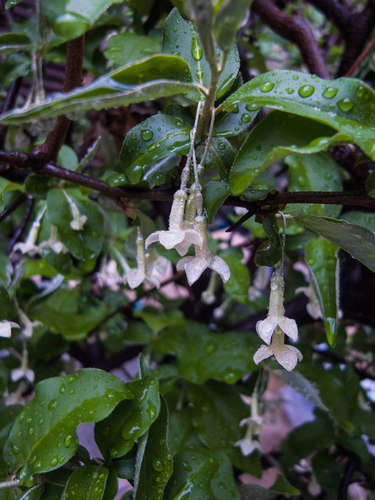
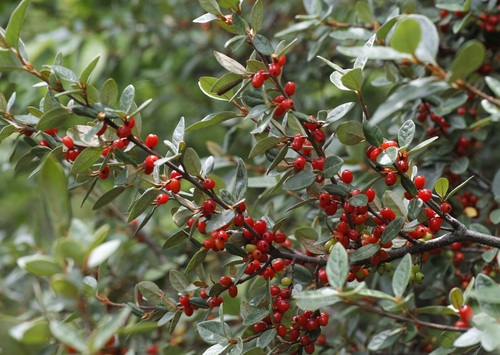
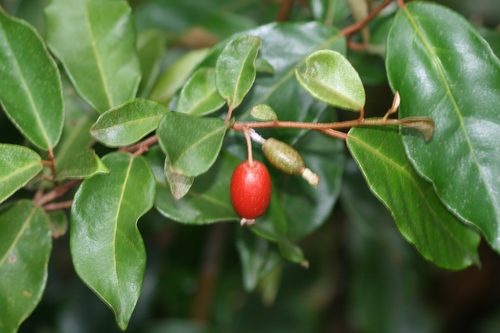
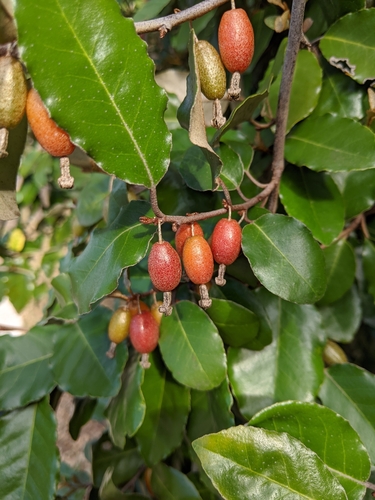
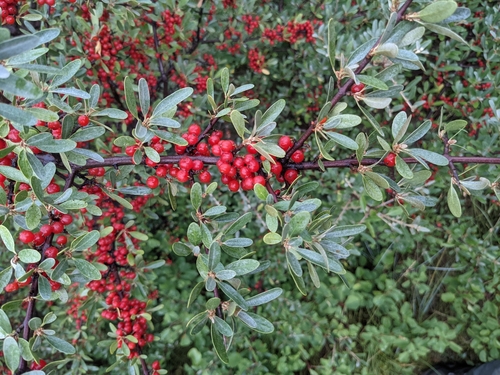
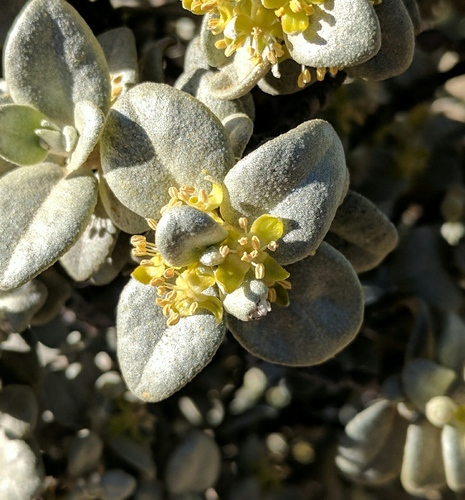
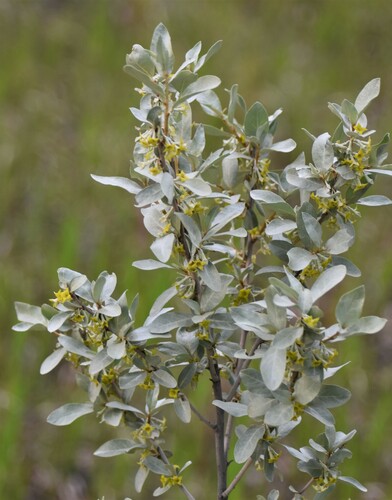
Elaeagnus commutata Bernh. ex Rydb. are fast-growing shrubs or small trees, reaching 1–4 meters (3+1⁄2–13 ft) in height and 2–5 meters in width. Their leaves are broad lanceolate, 2–7 centimeters (3⁄4–2+3⁄4 in) long, and silvery on both sides due to a covering of dense small white scales. The fragrant flowers are yellow, with a four-lobed corolla that measures 6–14 mm long. The fruits are ovoid drupes 9–12 mm long, also covered in silvery scales; the fruit pulp has a floury texture, and surrounds a single seed. In terms of ecology, sharp-tailed grouse and songbirds eat the fruits of this species, and it is a winter food source for sharp-tailed grouse. Silverberry is an important food for wildlife, and makes up over one quarter of the winter diet for moose in Montana. It also provides food for deer and elk. In North Dakota, it provides cover and nesting sites for mallards and many passerine birds. This species is cultivated as an ornamental plant, valued for its silvery foliage. Both its fruit and seeds are edible raw or cooked; the fruit is very astringent unless fully ripe. The fruit is a very rich source of vitamins and minerals, especially vitamins A, C, and E. It is also a fairly good source of essential fatty acids, which are rarely found in fruits. Like legumes, this plant is able to fix nitrogen. When grown as a companion plant in orchards, it has been documented to increase fruit production by ten percent. Traditionally, the fibrous bark of this plant has been twisted to make strong ropes, and woven into clothing and blankets. According to Arthur W. Bailey, "In rough fescue grasslands, silverberry at 1,000 stems per acre increases forage production."