About Eilema caniola (Hübner, 1808)
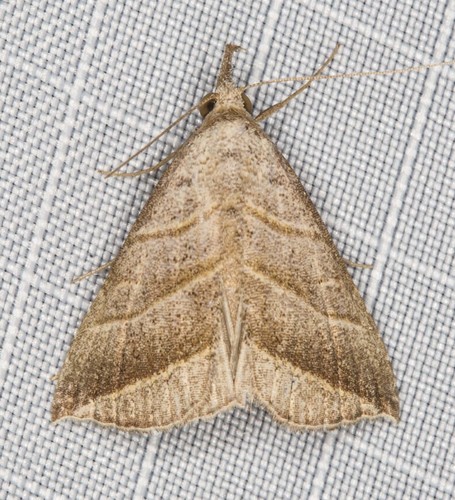
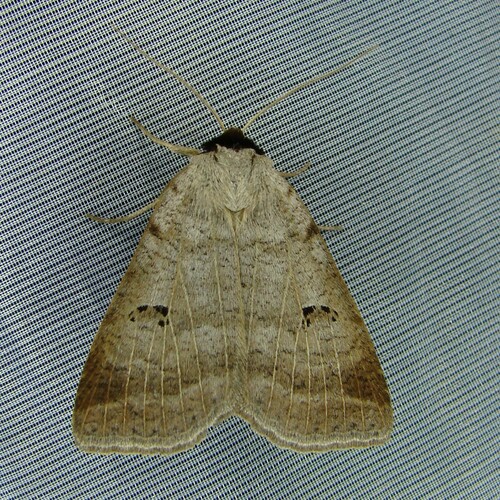
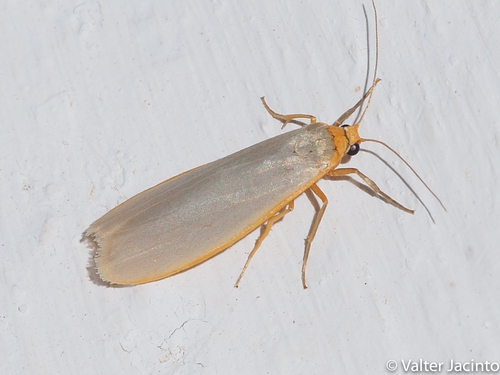
Eilema caniola (Hübner, 1808) has a wingspan of 28–35 mm. Its colouring is very similar to that of Eilema griseola and Eilema lurideola, but it differs from these two species in several key traits. Its forewings are much smaller, with an oblique outer margin that is only slightly excurved. The overall body colour is much lighter, a more yellowish grey, which makes the pale yellow costal stripe less prominent. Its hindwings are very pale, and are barely darker at the costal margin; the apex of the hindwing is much more pointed than it is in E. griseola and E. lurideola, the two species with which E. caniola is commonly confused. E. caniola can be immediately distinguished from Eilema complanum by the underside of its forewing: the pale grey colour of E. caniola’s forewing underside extends all the way to the margin, while E. complanum has a broadly yellow forewing margin. There are two documented aberrant forms of this species. The form ab. vitellina Bdv. has a forewing dusted with grey close to the distal margin, and males have a pale bright yellow ground colour. The form ab. albeola Hbn. is considerably smaller than typical specimens; it is entirely white on the upperside, with the exception of a bright yellow thorax, and occurs alongside standard coloured individuals of the species. Larvae of Eilema caniola are grey or reddish brown, with a dark dorsal line and red subdorsal lines edged with black, and occasionally have white or black spotting. This species is distributed across North Africa, western and southern Europe, eastern Europe extending up to south-western Russia, the Near East, the eastern Palearctic realm, and the Oriental realm. These thermophilic moths are usually found in urban areas; caterpillars are found on old walls, roofs, shingle beaches, and rocky areas.