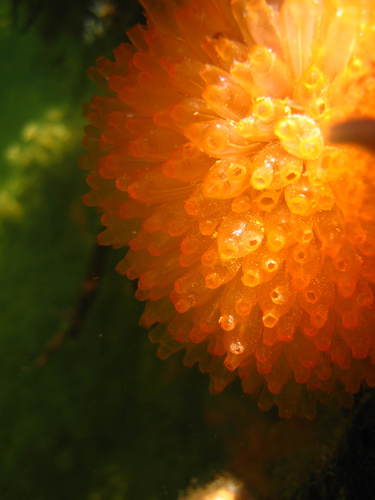
About Ecteinascidia turbinata Herdman, 1880
Ecteinascidia turbinata is a colonial sea squirt. Individual zooids of this species grow up to 2.5 cm (1 in) in height and have a wide-necked bottle shape. A connecting stolon at the base of the zooids links all members of the colony, allowing blood to circulate between individual zooids and anchoring the entire colony to a substrate. The outer body wall of each zooid is called a tunic, and it is strengthened with cellulose, a trait that is unusual for an animal. Siphons connect the interior of each zooid to the surrounding outside water. The tunic walls are translucent, making the internal pharyngeal basket visible through the wall. The margins of the siphons are orange from deposited carotenoids; this is warning colouration, as E. turbinata is distasteful and the colour deters predators. Whole colonies can reach up to 14 centimetres (5.5 in) in width. Ecteinascidia turbinata is present year-round in shallow waters of the Caribbean Sea, the east coast of Florida, Bermuda, and the Gulf of Mexico. In summer, it is occasionally found in Chesapeake Bay, off the coasts of North and South Carolina, and in the Mediterranean Sea. This species grows primarily on the submerged roots of the red mangrove Rhizophora mangle. In Cuba, where the species is abundant, populations can reach densities of one colony per metre of mangrove root. It can also grow on rocks, jetties, corals of the genus Antipathes, floating debris, and on or around seagrasses. Vanadium compounds accumulate in the tunic of Ecteinascidia turbinata, reaching total concentrations that can be one million times higher than the concentration of vanadium in the surrounding seawater. The function of these accumulated compounds is uncertain, but when combined with certain alkaloids, they make the tunicate distasteful to predators, and the organism's bright orange colouring advertises this unpalatability. The flatworm Maritigrella crozierae is apparently immune to the sea squirt's defensive chemicals; it crawls over the surface of E. turbinata colonies and inserts a long pharynx into individual zooids to feed on their internal structures. Other biofouling organisms commonly found near Ecteinascidia turbinata include various marine sponges and other tunicate species. Several species of amphipod live symbiotically inside the zooids of this sea squirt. Ecteinascidin 743, also called trabectedin, is an alkaloid produced by a bacterial symbiont that lives with Ecteinascidia turbinata. This compound has been found to have antitumor antibiotic properties, and it has been approved by EU and United States drug regulators under the trade name Yondelis for the treatment of certain soft tissue sarcomas and recurrent ovarian cancer.

