About Ecliptopera capitata (Herrich-Schäffer)
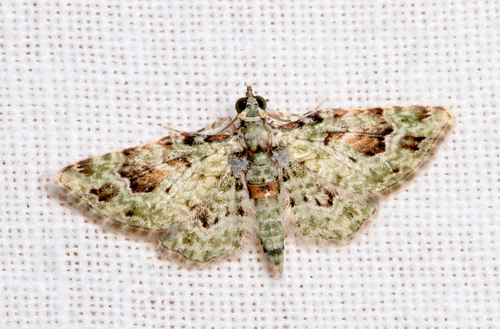
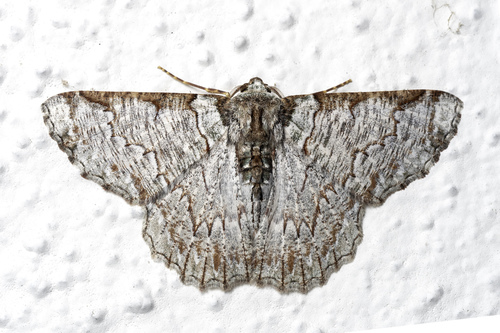
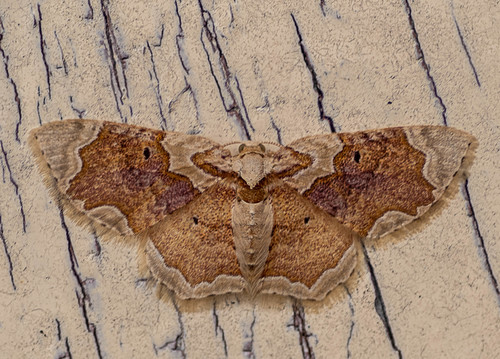
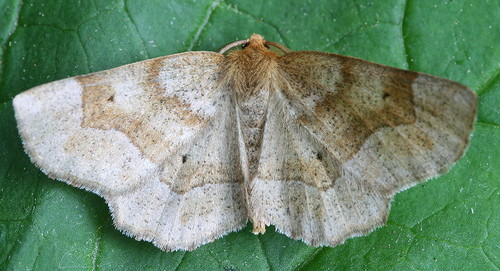
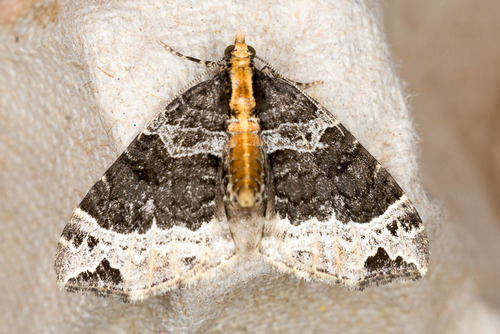
Ecliptopera capitata (Herrich-Schäffer) is a moth belonging to the family Geometridae. This species is distributed across Europe, and extends east across the Palearctic region all the way to Japan. The forewings of this moth measure 11–13 mm in length. It is a slender, pale brownish-grey moth, and can be recognized by specific forewing traits: its broad transverse forewing band is fairly evenly wide, with a shallow triangular notch on its inner side, and there is a dark spot at the outer edge of the forewing. Both males and females have filamentous antennae. The forewing is light grey, and is darker grey at its base. In the center of the forewing sits a broad, grey transverse band. This band is no more than one and a half times as wide at the leading edge as it is at the hind edge, it has a shallow, right-facing triangular notch on its inner side, and is slightly wavy along its outer edge. Outside the transverse band, there is a row of dark, arrow-shaped spots; these spots are largest at the anterior edge, and become indistinct in the posterior half of the row. At the outer edge of the wing, there is an oblong, dark spot. The hindwing is silky greyish-white, darker at the hind corner, and marked with faint, grey transverse bands. The larva of Ecliptopera capitata is long and thin, hairless, and pale greenish-pink in colour. A description provided by Warren in Seitz notes that this species is very closely related to Ecliptopera silaceata. On average, it is somewhat smaller than E. silaceata, with slightly rounder wings, being intermediate in this trait towards Ecliptopera decurrens. The thorax (excluding the tegulae) and abdomen are pale ochreous on the dorsal side. Dark markings on the forewing are typically darker on average than in E. silaceata. The median band of the forewing is never intersected by white along the veins, its proximal margin is less deeply angulated, the posterior half of the distal wing area is weakly marked, and it carries some light ferruginous clouding that is somewhat similar to that seen in E. decurrens. The subspecies E. c. capitulata (Staudinger, 1897), originally described as Ecliptopera capitulata Stgr., is smaller than the nominal form. The distal area of its forewing is a duller, dirty grey rather than brownish, and the subbasal area of the forewing and the hindwing are also somewhat darkened. This subspecies occurs in the Amur and Ussuri districts, and appears as an aberration in Hakodate, Japan. The type specimen of Butler's mariesiti, now a synonym of E. c. capitulata, is somewhat transitional between forms. Adult moths produce two generations annually, flying from May to August. The larvae of this species feed on touch-me-not balsam.