About Echium vulgare L.
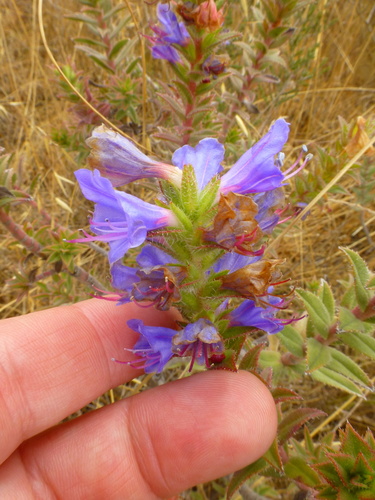
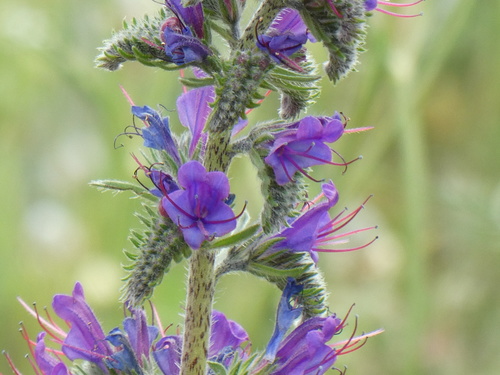
Echium vulgare L. is a biennial or monocarpic perennial plant that reaches 30–80 cm (12–31 in) in height. It has rough, hairy, oblanceolate leaves, and red-flecked stems that resemble snake skin; even its fruits are shaped like adder heads. Its flowers start pink and turn vivid blue, measure 15–20 mm (0.59–0.79 in), and are arranged in branched spikes, with all stamens protruding. The pollen is blue, while the stamen filaments stay red, creating a contrast with the blue flowers. In the Northern Hemisphere, it flowers between May and September. The Latin specific epithet vulgare means common. This species is native to Europe and temperate Asia. It has been introduced to Chile, New Zealand, and North America, where it is naturalized in parts of the continent, including Ontario and northern Michigan, and is listed as an invasive species in Washington. It grows in dry, calcareous grassland, heaths, bare and waste places, along railways and roadsides, and on coastal cliffs, sand dunes, and shingle. E. vulgare is cultivated as an ornamental plant, and many cultivars have been developed. The cultivar 'Blue Bedder' has earned the Royal Horticultural Society's Award of Garden Merit.