About Echium candicans L.fil.
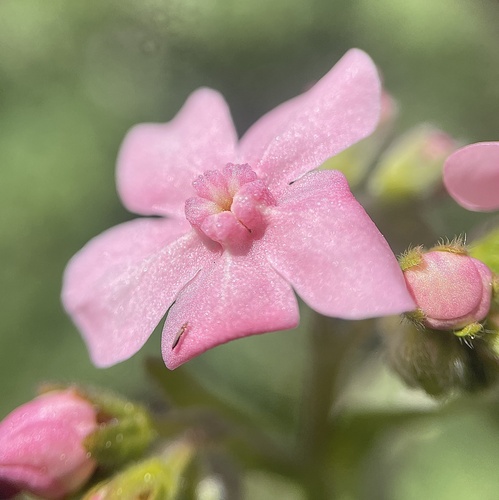
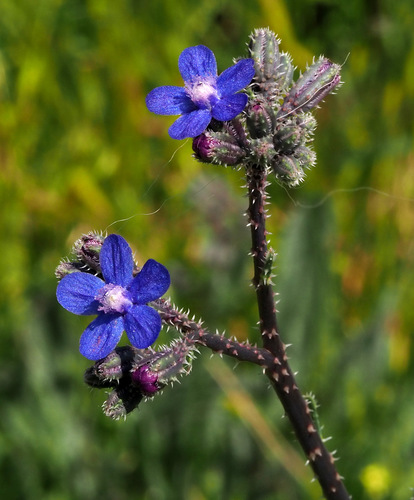
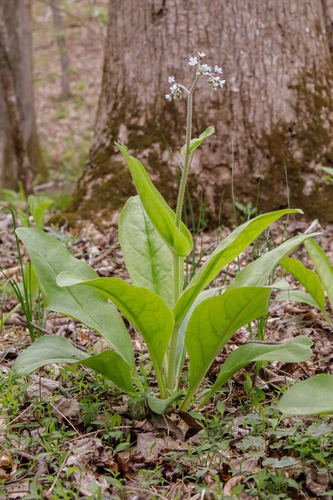
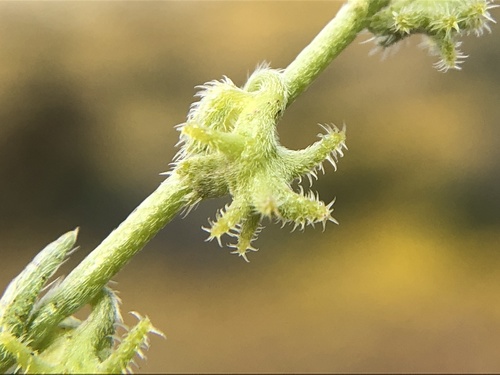
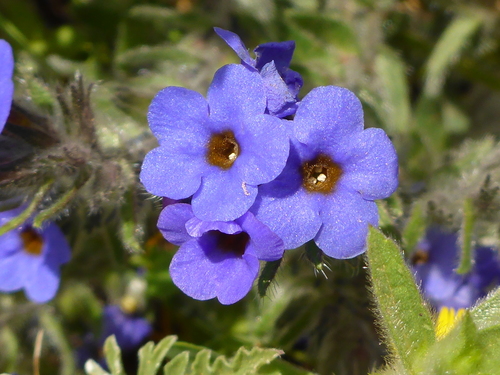
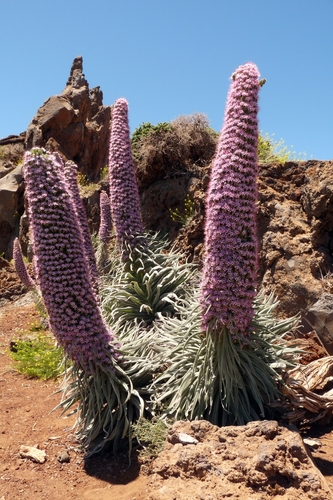
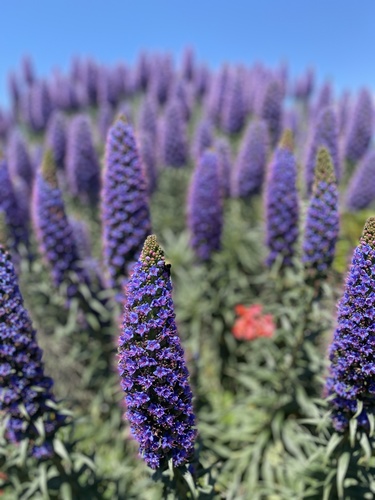
Echium candicans L.fil. grows as a 1 to 2 meter tall shrub, typically with a candelabra-like growth form. Its inflorescences form terminally on side shoots, not on the main terminal shoot. The whitish bark peels off shoots like paper. Its short-stalked leaves are lanceolate to ovate-lanceolate with a long pointed tip, reaching a maximum length of 25 centimeters and a width of 2 to 4 centimeters. Lower leaves are more than five times as long as upper leaves. The upper (adaxial) side of the leaf blade is dark green, while the lower side is a slightly lighter green with prominent veins. All parts of the plant are covered in dense, soft, relatively long, protruding velvety hairs. Many flowers and bracts are arranged in a dense, narrow, elongated inflorescence that is 10 to 25 centimeters long, and can reach up to 47 centimeters in maximum length. The flowers are hermaphrodite, sessile, five-parted with a double perianth, and weakly zygomorphic, a trait that differs from the flowers of most other genera in the Boraginaceae family. Flowers are blue or purple, and bloom from spring to summer. The calyx is 4 to 5 millimeters long, green, hairy, lacks darker veins, and has lanceolate, pointed calyx lobes. The corolla ranges from blue to violet, often with a white stripe on each lobe apex; the flower tube is 9 to 11 millimeters long, and the corolla apex is rounded or truncated. The stamens are pink, with whitish anthers. Large flower heads may also bear white or blue flowers with red stamens, and are frequently visited by bees and butterflies to collect nectar. This species is native only to the island of Madeira, and does not occur naturally on other islands in the Madeira archipelago. On Madeira, it grows relatively commonly at altitudes of 800 to 1200 meters in the central part of the island, at the upper end of the elevation range of laurel forest, and in open, heather-like vegetation. Echium candicans is cultivated in the horticultural trade, and is widely available around the world as an ornamental plant for traditional gardens and drought-tolerant, water-conserving gardens. It is especially suited to coastal planting. It requires temperatures no lower than 5–7 °C (41–45 °F), so it needs winter protection in areas prone to frost. It has been awarded the Royal Horticultural Society's Award of Garden Merit. In California, it is classified as an invasive species, and is removed from native plant communities during habitat restoration work in coastal parks including the Golden Gate National Recreation Area. In New Zealand, it is a common garden escapee that grows on roadside verges and shingle banks throughout drier regions of both the North and South Islands. In the state of Victoria, Australia, it is considered to carry a high weed risk, and an official alert about it has been issued by the Department of Primary Industries.