About Echinops sphaerocephalus L.
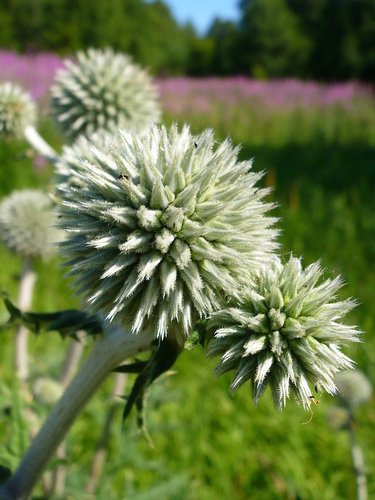
Echinops sphaerocephalus L. is a glandular, woolly perennial herbaceous plant. On average, it reaches 50–100 centimetres (20–39 in) in height, and occasionally grows up to 200 cm (80 inches) tall. It has erect, branching, gray, slightly wrinkled, hairy stems, which bear occasional large, soft green leaves that are sharply toothed, sharply lobed, and end in a point. The upper surface of these leaves is covered in sticky hairs, while the lower surface is covered in dense white woolly hairs. At the top of each stem sits an almost perfectly spherical inflorescence, up to 6 cm in diameter, packed full of white or blue-gray disc florets. This species flowers from June through September. Its flowers are hermaphrodite, capable of self-fertilization (autogamy), and are pollinated by insects (most often bees, wasps and butterflies) through entomogamy. The fruits are hairy cylindrical achenes, about 7 to 8 mm long. These fruits ripen from September through October, and its seeds are dispersed by wind via anemochory. This species is widespread across most of Eurasia, and has been introduced to other continents, where it now grows. In North America it is a widespread weed. It is very common in the mountains of southern France, as well as the mountains of southern and central Europe. It grows in sunny, rocky or brushy locations, in more or less mineral-rich soils, at altitudes between 0 and 400 metres (0–1,312 ft) above sea level. Three currently accepted subspecies are: Echinops sphaerocephalus subsp. albidus (Boiss. et Spruner) Kozu., Echinops sphaerocephalus subsp. sphaerocephalus, and Echinops sphaerocephalus subsp. taygeteus (Boiss. & Heldr.) Kožuharov.