About Echinoderma asperum (Pers.) Bon
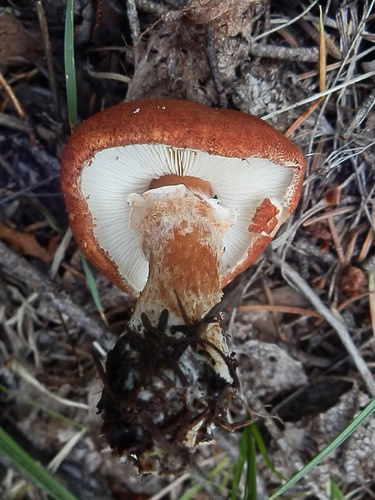
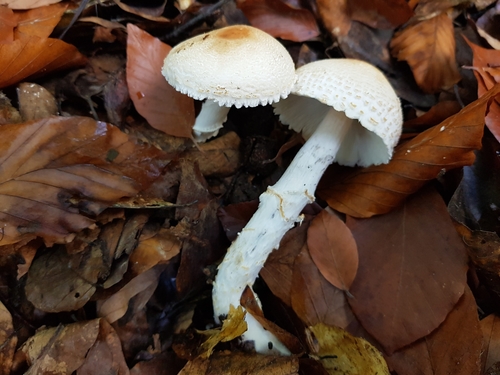
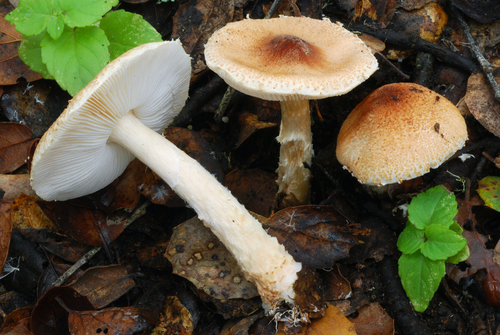
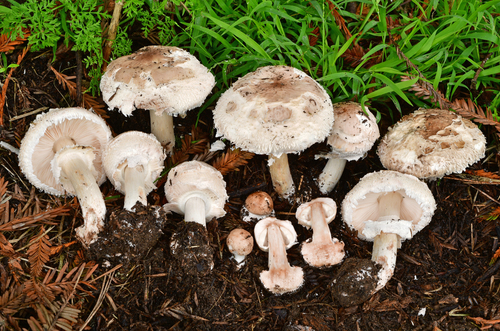
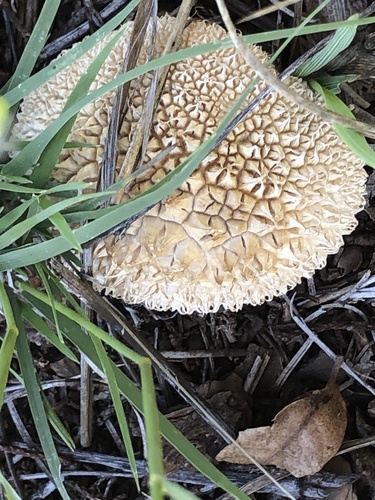
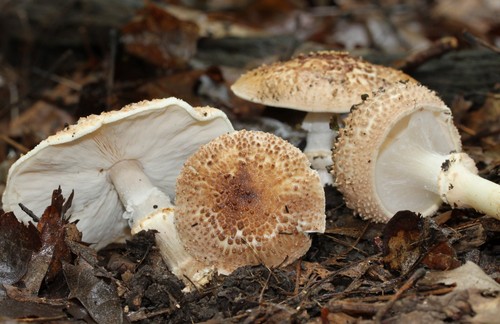
Echinoderma asperum (Pers.) Bon has a cap that is oval when young, becoming convex or campanulate with age. The cap is uniformly reddish-brown or brown at the center, and breaks up into erect pyramidal scales over a paler background; it reaches up to 10 centimeters (4 inches) in width. The stem is paler than the cap, around 10 cm long, and bears sparse brown scales below its ring. The ring is large and cottony, sometimes adhering to the edge of the cap, and often picks up brownish scales from the cap, which are visible on the ring's edge. The gills are free, crowded, white, and have a tendency to fork; the spore print is also white. The flesh is white, and is reported to smell like rubber, the earth ball Scleroderma citrinum, or the mushroom Lepiota cristata. Echinoderma asperum fruits in autumn, growing in deciduous woodland, or in parks and gardens where wood chip mulch has been used. It has been widely recorded across northern temperate zones: its frequency varies from common to quite rare in Europe and North Africa, it occurs in North America, and it has been reported in Japan, Australia and New Zealand. A study of L. aspera species diversity in northern Thailand, conducted between 2007 and 2010 in Chiang Mai and Chiang Rai provinces, reported the collection of roughly 73 Lepiota mushrooms representing 33 species. These 33 species were grouped as follows: 11 in the Stenosporae group, 8 in Ovisporae, 6 in Lepiota, 5 in Liliaceae, and 3 in Echinacea. The highest diversity was found in the Stenosporae group, which had a diversity index of 2.20.